Studies
Is Titanium Dioxide in Loose Powder Safe to Inhale?
Inhaling titanium dioxide from loose powders poses a theoretical risk due to nanoparticle size and lung vulnerability; occupational studies link high exposure.
May 22, 2026
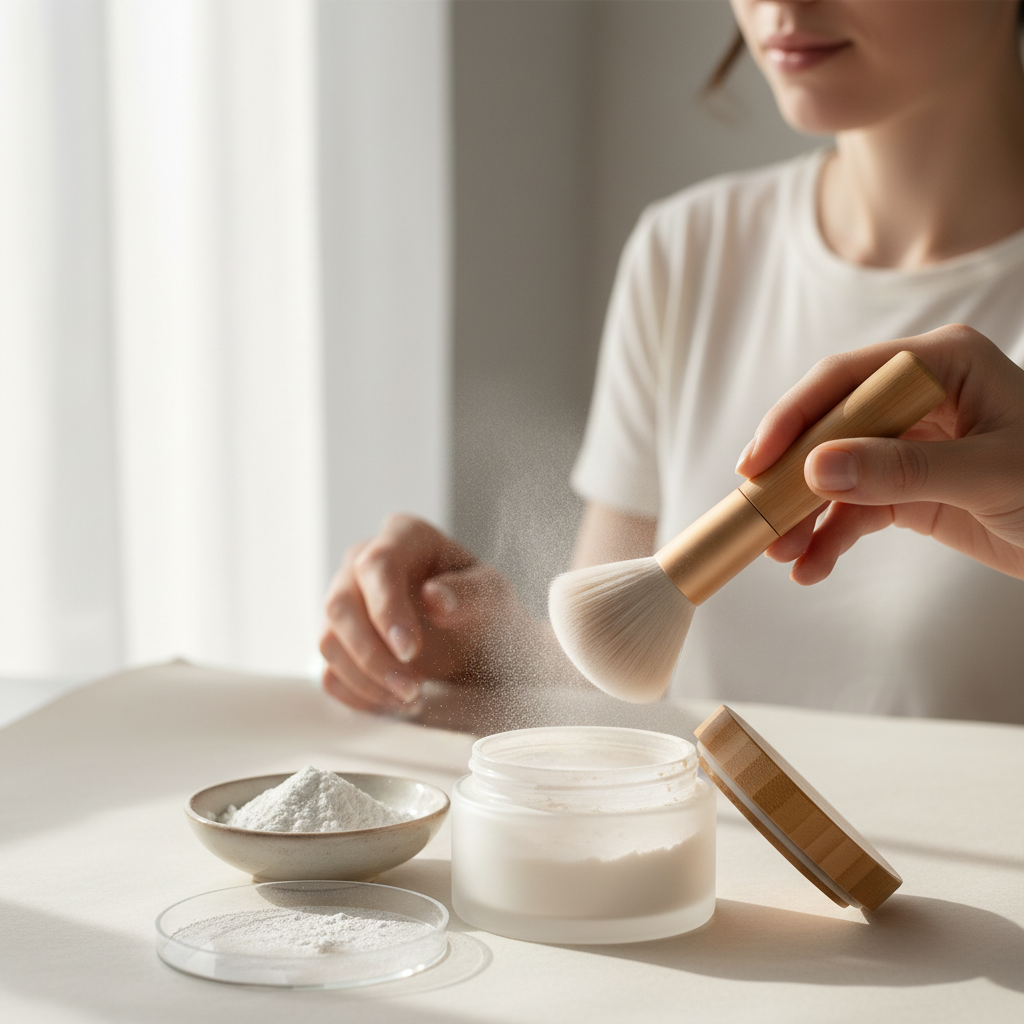
[!answer] Titanium dioxide is a mineral pigment generally considered safe in skincare, but inhaling its nanoparticles, as can occur with loose or pressed powders, poses a theoretical risk. High-dose occupational exposure is linked to lung inflammation, and while cosmetic use is much lower, the long-term effects of chronic, low-grade inhalation are not yet fully understood.
Titanium dioxide is a stalwart of the mineral makeup and sunscreen world, prized for its opacity and broad-spectrum UV protection. But as formulations have evolved, so have the questions about their safety. When this mineral is milled into ultrafine particles for a silky, lightweight powder, it can become airborne during application, raising an important question: what happens when we breathe it in?
What is titanium dioxide?
Titanium dioxide (TiO2) is a naturally occurring mineral oxide of titanium. In its raw form, it’s a brilliant white powder, and it’s used in everything from paint and plastics to food and pharmaceuticals. In the cosmetic industry, it serves two primary functions: as a potent white pigment to provide coverage in foundations and concealers, and as a physical UV filter in sunscreens, where it reflects and scatters harmful ultraviolet rays away from the skin.
Its safety on top of the skin is well-established. It’s chemically inert, stable, and generally not absorbed by healthy, intact skin, which is why it’s a go-to for sensitive skin-friendly sunscreens. However, the safety profile of an ingredient can change dramatically depending on its form and route of exposure. When held within a cream, lotion, or pressed cake, TiO2 particles are mostly fixed. But in a loose powder, these particles are free, and with every swirl of a brush, a small, invisible cloud can be aerosolized and inhaled.
Why is inhalation a special concern?
Our bodies are equipped with sophisticated defense systems, and the epithelial barrier is one of the most important. This thin layer of cells lines our skin and our internal mucosal surfaces, including the respiratory and digestive tracts. It’s our first line of defense against pathogens, pollutants, and foreign substances [2]. Over the past half-century, an unprecedented number of new chemicals—over 350,000—have been introduced into our environment, continuously challenging the integrity of these barriers [3].
[!quote] More than 350,000 new chemicals have been introduced to our lives, mostly without any reasonable control of their health effects and toxicity. — [2]
The lungs represent a uniquely vulnerable part of this barrier. Unlike the skin, the lung’s interior surface—the alveolar region—is incredibly thin and has an enormous surface area, all designed to facilitate efficient gas exchange with the bloodstream. This very efficiency makes it a potential route for unintended substances to enter the body. In fact, pharmaceutical science is actively exploring the lungs as a non-invasive route for delivering drugs via nanoparticles precisely because of this direct path to the circulatory system [5]. If the lungs are an effective way to get medicine into the body, it stands to reason they are also an effective route for other fine particles we might encounter.
What does the research on TiO2 inhalation actually say?
The concern around inhaling titanium dioxide doesn’t come from studies on makeup users. It originates from decades of occupational health research on workers in factories that produce or use large quantities of TiO2 dust. In these high-exposure settings, long-term, daily inhalation of fine and ultrafine TiO2 particles is linked to respiratory irritation, lung inflammation, and a type of lung disease called pulmonary fibrosis.
Based on this robust body of evidence from animal and human occupational studies, the International Agency for Research on Cancer (IARC) classified titanium dioxide as a "Group 2B" carcinogen, meaning it is “possibly carcinogenic to humans” by the inhalation route only. This classification can sound alarming, but it’s a reflection of hazard, not necessarily everyday risk. It signifies that at high enough concentrations, the substance has the potential to cause cancer in animal models, but the evidence in humans is limited. For context, other Group 2B substances include things like coffee and pickled vegetables.
Still, this data signals a clear biological mechanism: fine TiO2 particles, when inhaled deeply and persistently, can overwhelm the lung’s clearing mechanisms and trigger a chronic inflammatory response [1]. The critical question for cosmetic users is whether the small, intermittent exposure from a daily powder application is enough to pose a similar, albeit smaller, risk over a lifetime.
Are nanoparticles the key factor?
Yes, particle size is central to the discussion. Titanium dioxide used in cosmetics comes in various grades, including pigment-grade (larger particles) and nano-grade (ultrafine particles). Nanoparticles are those smaller than 100 nanometers. To put that in perspective, a human hair is about 80,000-100,000 nanometers wide. This incredibly small size is desirable in sunscreens for a transparent finish and in powders for a silky, non-cakey texture.
However, it is this same small size that enables particles to be inhaled deep into the furthest reaches of the lungs—the alveoli—where they are most likely to get stuck and interact with sensitive tissue [5]. Bigger particles, by contrast, are more likely to be trapped higher in the respiratory tract (in the nose and throat) and cleared away by mucus. While some brands advertise the use of "non-nano" titanium dioxide in their powders to allay these fears, the milling and pressing process can create a range of particle sizes, and testing for airborne nanoparticles during actual use is complex and rarely performed.
How do regulators view this risk?
Major regulatory bodies, including the FDA in the United States and the European Commission’s Scientific Committee on Consumer Safety (SCCS), have reviewed the safety of titanium dioxide extensively. Both consider it safe for use in topical cosmetics, including sunscreens, when applied to healthy skin.
However, they share the concerns about inhalation. The SCCS has explicitly stated that its safety opinions on TiO2 do not apply to products where inhalation exposure is a significant risk, such as powders or aerosol sprays. For this reason, the EU has banned the use of titanium dioxide in sprayable applications where the particles could be inhaled. Concerns about inhaling cosmetic ingredients are not new, with similar questions arising about contaminants in aerosol products like benzene in some dry shampoos.
This regulatory stance is a classic example of the precautionary principle. While there is no direct evidence showing that using loose powder causes lung disease in humans, the potential hazard identified in occupational settings is significant enough to warrant caution for any product that could turn TiO2 into an inhalable aerosol. Adverse event reports submitted to the FDA often mention respiratory reactions to cosmetics, though these are not specific enough to pinpoint a single ingredient [7][8][9][10].
[!quote] The "epithelial barrier theory" suggests that genetic predisposition and exposure to diverse factors damaging the epithelial barriers contribute to the emergence of allergic and autoimmune conditions. — [3]
How can I be more cautious with my powder makeup?
For those who love their loose mineral foundation or setting powder, this doesn't necessarily mean you have to throw it out. It does, however, suggest a more mindful approach to application can significantly reduce your exposure. The goal is to minimize the amount of powder that becomes airborne.
Simple techniques can make a big difference. Instead of dipping your brush in and shaking off the excess, tap the minerals into the jar’s lid, swirl the brush firmly to pick up the product, and then tap the base of the brush on the counter to settle the powder down into the bristles before applying. This "tap, swirl, tap" method loads the brush efficiently without creating a dusty cloud. Applying makeup in a well-ventilated space and even briefly holding your breath during the moment of application can also help.
If you have a pre-existing respiratory condition like asthma, are a heavy daily user of powders, or simply prefer to err on the side of caution, you might consider alternatives. Cream or liquid foundations, concealers, and blushes, as well as pressed powders, tend to generate far fewer airborne particles and present a negligible inhalation risk. Reading your labels is always a good first step, but in this case, the product's form is just as important as its ingredient list.
The takeaway
Titanium dioxide remains a safe and effective cosmetic ingredient when applied topically in creams and lotions. The scientific consensus starts to blur when it's in a form that can be easily inhaled, like loose powders. While no study has directly linked cosmetic powder use to lung disease, the well-established occupational risks of inhaling TiO2 nanoparticles suggest a prudent and evidence-based approach is to minimize your exposure where possible.
Sources
- [1] The dark side of beauty: an in-depth analysis of the health hazards and toxicological impact of synthetic cosmetics and personal care products. — Alnuqaydan AM.. 2024 · Europe PMC
- [2] Effect of altered human exposome on the skin and mucosal epithelial barrier integrity. — Pat Y, Ogulur I, Yazici D, Mitamura Y, Cevhertas L, Küçükkase OC, Mesisser SS, Akdis M, Nadeau K, Akdis CA.. 2023 · Europe PMC
- [3] Epithelial barrier dysfunction and associated diseases in companion animals: Differences and similarities between humans and animals and research needs. — Ardicli S, Ardicli O, Yazici D, Pat Y, Babayev H, Xiong P, Zeyneloglu C, Garcia-Sanchez A, Shi LL, Viscardi OG, Skolnick S, Ogulur I, Dhir R, Jutel M, Agache I, Janda J, Pali-Schöll I, Nadeau KC, Akdis M, Akdis CA.. 2024 · Europe PMC
- [4] TFOS Lifestyle: Impact of cosmetics on the ocular surface. — Sullivan DA, da Costa AX, Del Duca E, Doll T, Grupcheva CN, Lazreg S, Liu SH, McGee SR, Murthy R, Narang P, Ng A, Nistico S, O'Dell L, Roos J, Shen J, Markoulli M.. 2023 · Europe PMC
- [5] Liposomes or Extracellular Vesicles: A Comprehensive Comparison of Both Lipid Bilayer Vesicles for Pulmonary Drug Delivery. — Al-Jipouri A, Almurisi SH, Al-Japairai K, Bakar LM, Doolaanea AA.. 2023 · Europe PMC
- [6] UEG Week 2025 Moderated Posters. 2025 · Europe PMC
- [7] OpenFDA Cosmetic Adverse Event Report (#1). FDA Adverse Event Reporting System (2017) · OpenFDA
- [8] OpenFDA Cosmetic Adverse Event Report (#2). FDA Adverse Event Reporting System (2022) · OpenFDA
- [9] OpenFDA Cosmetic Adverse Event Report (#3). FDA Adverse Event Reporting System (2024) · OpenFDA
- [10] OpenFDA Cosmetic Adverse Event Report (#4). FDA Adverse Event Reporting System (2021) · OpenFDA