Ingredients
Phenoxyethanol Absorption: What Science Says About Skin Safety
Phenoxyethanol in leave-on skincare is minimally absorbed. The body rapidly metabolizes and excretes the tiny amount that enters, with regulators finding it.
May 22, 2026
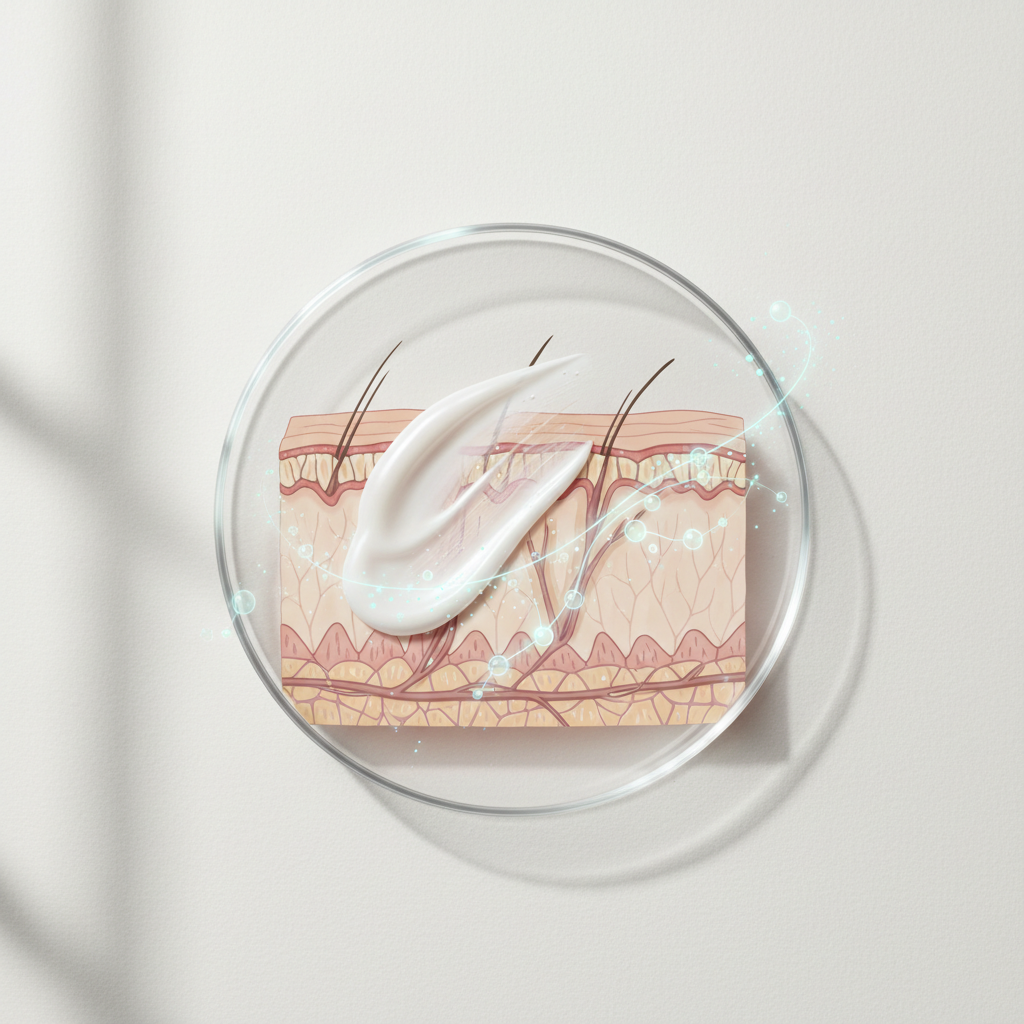
[!answer] Phenoxyethanol, a preservative in leave-on skincare, exhibits very low absorption through intact skin. The small amount that does penetrate is rapidly metabolized by the body into phenoxyacetic acid and safely excreted through urine. Global regulatory bodies consider it safe for adults at its typical concentration of up to 1%.
This scientific consensus forms the basis of its widespread use as a preservative. Yet, the conversation around any synthetic ingredient being applied to and absorbed by our skin deserves a closer, more nuanced look.
What is phenoxyethanol and why is it used in skincare?
Phenoxyethanol is a preservative, and its primary job is to keep your skincare products safe and free from contamination. It’s a clear, oily liquid that works by preventing the growth of bacteria, yeasts, and mold that could otherwise proliferate in water-based cosmetics like lotions, creams, and serums. Without an effective preservative system, a moisturizer could become a petri dish for harmful microbes within days or weeks, posing a much more immediate risk to your health than the preservative itself.
Its use became widespread as formulators sought alternatives to parabens. It has a broad spectrum of antimicrobial activity, is stable at various temperatures and pH levels, and is compatible with a wide range of other cosmetic ingredients. This versatility makes it a reliable choice for ensuring product integrity and consumer safety. As we explore in our broader Phenoxyethanol in Skincare: A Scientific Safety Review, its function is purely protective, maintaining the stability and safety of the active ingredients in a formulation [1][5].
How does skin absorption work?
The skin is not a sponge, but it’s not an impenetrable barrier either. The outermost layer, the stratum corneum, is a highly effective wall made of flattened, dead skin cells (corneocytes) embedded in a lipid-rich mortar. For any substance to be absorbed, it must bypass this barrier. Several factors determine whether a cosmetic ingredient can make the journey: its molecular size and weight, its solubility in fats and water (lipophilicity), and the overall formulation of the product it’s in [3].
Small molecules that are soluble in lipids have an easier time navigating the fatty matrix of the stratum corneum. The health of your skin also plays a critical role; a compromised skin barrier, from dryness, wounds, or a condition like eczema, is more permeable than healthy, intact skin. Ultimately, the skin’s primary role is to keep things out. While certain active ingredients are designed with sophisticated delivery systems like nanoparticles or microcapsules to enhance their penetration and bioavailability [3][4], that is not the goal for a preservative like phenoxyethanol. For preservatives, the ideal scenario is that they stay within the product on the skin
What does the research say about how much is actually absorbed?
To determine the real-world impact of phenoxyethanol, scientists measure its absorption rate using both laboratory (in vitro) and human (in vivo) studies. The most influential data comes from studies reviewed by regulatory bodies like Europe’s Scientific Committee on Consumer Safety (SCCS). One key in vitro study used human skin samples to test the absorption from a cream containing the maximum permitted 1% concentration of phenoxyethanol. The results showed that over a 24-hour period, only a very small fraction—less than 6% of the total applied dose—actually penetrated the skin barrier. This experiment was conducted under "occlusive" conditions, meaning the skin was covered, which tends to maximize absorption and represents a worst-case scenario compared to normal use where the product is open to the air.
Further analysis within these studies confirms that what does get absorbed does not linger in the body. The small amount of phenoxyethanol that makes it into systemic circulation is rapidly processed by the liver. It is metabolized into a compound called phenoxyacetic acid, a water-soluble substance that the body can easily handle. This metabolite is then efficiently filtered by the kidneys and excreted from the body in urine, typically within 24 to 48 hours. There is no evidence from clinical or animal data to suggest that phenoxyethanol bioaccumulates or builds up in tissues over time with repeated use.
These findings from human skin models are strongly supported by older in vivo studies conducted on animals. When phenoxyethanol was applied to the skin of rats, researchers observed similarly low levels of dermal absorption and rapid excretion. This consistency across different types of evidence gives regulators high confidence in the data. The consensus is that when applied to intact skin in a standard cosmetic formulation, the systemic exposure to phenoxyethanol is minimal and poses no risk of toxicity because the dose that enters the body is far too low to have a biological effect.
Are there safety concerns for infants or sensitive skin?
The safety of phenoxyethanol for use on infants has been a specific point of discussion. In 2012, the French National Agency for the Safety of Medicines and Health Products (ANSM) issued a precautionary recommendation to avoid using phenoxyethanol in products intended for the diaper area of children under three. Their concern was based on the unique conditions of this area: the skin is often irritated, a diaper creates an occlusive effect, and infants have a higher surface-area-to-body-weight ratio, all of which could theoretically lead to increased absorption. This recommendation prompted a thorough re-evaluation by the SCCS.
After reviewing all available toxicological and absorption data, including the specific scenarios raised by the ANSM, the SCCS reaffirmed its position in 2016. The committee concluded that phenoxyethanol is safe for all consumers, including children of all age groups, when used as a preservative in cosmetic products at a maximum concentration of 1%. They calculated the Margin of Safety for children under three, even for diaper-area products, and found it to be well above the required safety threshold. They determined that the very low rate of skin penetration provides a sufficient safety buffer even for this vulnerable group.
For individuals with a compromised skin barrier, such as those with eczema, psoriasis, or active wounds, the primary concern is usually local irritation rather than systemic toxicity. While a damaged stratum corneum is more permeable to all substances, the total amount of phenoxyethanol absorbed from a 1% cream is still considered too low to pose a systemic health risk. The more relevant issue is the potential for stinging, burning, or a flare-up of their skin condition. Although phenoxyethanol is not considered a primary skin sensitizer or a common cause of allergic contact dermatitis, those with hypersensitive skin may react to it, as they can to many ingredients. A patch test is always a wise precaution when introducing any new product to inflamed or reactive skin.
Sources
- [1] Microencapsulated α-Tocopherol and Moringa Extract for Improved Skin Protection: Insights From Human Skin Assessment in Cosmetic Formulations. — Kessler JC, Martins IM, Manrique YA, Gudjónsdóttir SD, Rodrigues AE, Barreiro MF, Dias MM.. 2025 · Europe PMC
- [2] The Skin Microbiome and Bioactive Compounds: Mechanisms of Modulation, Dysbiosis, and Dermatological Implications. — Wojciechowska K, Dos Santos Szewczyk K.. 2025 · Europe PMC
- [3] SLNs and NLCs for Skin Applications: Enhancing the Bioavailability of Natural Bioactives. — Safta DA, Bogdan C, Moldovan ML.. 2024 · Europe PMC
- [4] Vitamin D-loaded lipid nanoparticles: antioxidant properties, preparation, optimization, and in vitro characterization. — Al-Smadi K, Imran M, Abdoh A, Liu D, Phan K, Filho NA, Leite-Silva VR, Mohammed Y.. 2025 · Europe PMC
- [5] Advances in plant essential oils and drug delivery systems for skincare. — Yihan W, Jinjin D, Yingqi W, Guanai M, Xiwu Z.. 2025 · Europe PMC
- [6] Mass-Spectrometry-Based Research of Cosmetic Ingredients. — Serb AF, Georgescu M, Onulov R, Novaconi CR, Sisu E, Bolocan A, Sandu RE.. 2024 · Europe PMC
- [7] OpenFDA Cosmetic Adverse Event Report (#1). FDA Adverse Event Reporting System (2025) · OpenFDA
- [8] OpenFDA Cosmetic Adverse Event Report (#2). FDA Adverse Event Reporting System (2019) · OpenFDA
- [9] OpenFDA Cosmetic Adverse Event Report (#3). FDA Adverse Event Reporting System (2016) · OpenFDA
- [10] OpenFDA Cosmetic Adverse Event Report (#4). FDA Adverse Event Reporting System (2014) · OpenFDA