Guides
A Guide to Endocrine Disruptors in Your Cosmetics
Endocrine disrupting chemicals (EDCs) like certain parabens, phthalates, and UV filters are used in personal care. Learning to read labels helps you avoid them.
May 25, 2026
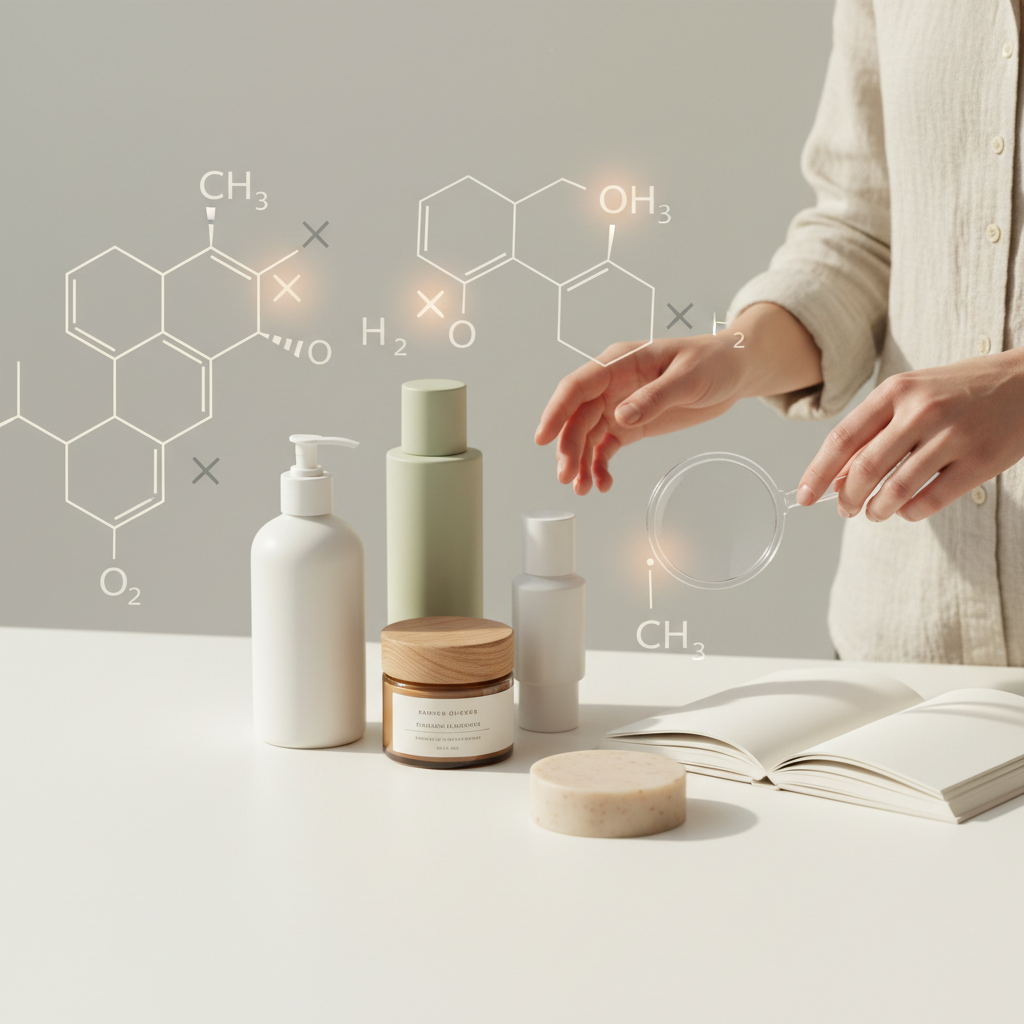
[!answer] Endocrine-disrupting chemicals (EDCs) are substances that can interfere with the body's hormonal system. In cosmetics, common examples include certain parabens, phthalates, and UV filters. Identifying them requires reading ingredient lists for specific chemical names, as scientific evidence on their long-term health effects at typical exposure levels continues to evolve.
Personal care products are a cornerstone of modern wellness, designed to clean, protect, and enhance. Yet, the very formulations we trust on our skin often contain complex chemical profiles, including compounds that are under increasing scientific scrutiny for their potential to interact with our hormones.
What are endocrine disruptors, and how do they work?
Endocrine-disrupting chemicals, or EDCs, are exogenous substances—meaning they originate outside the body—that can interfere with the endocrine system. This system is a network of glands that produce and secrete hormones, the chemical messengers that regulate nearly every process in the body, from metabolism and growth to mood and reproduction. EDCs can exert their effects in several ways: by mimicking natural hormones, blocking hormone receptors, or interfering with how hormones are made, transported, or broken down [1].
These chemicals are not rare or obscure; they are widespread in our daily environment, found in everything from plastics and pesticides to everyday consumer products [2]. Because they can act on the body even at very low concentrations, there is a robust scientific conversation about what constitutes a safe level of exposure, especially when that exposure is chronic and comes from multiple sources simultaneously.
Why are EDCs used in personal care products?
It’s a fair question: if these chemicals are so controversial, why are they in our products at all? The answer lies in their functional properties, which are highly effective and difficult to replace. Parabens, for instance, are excellent preservatives that prevent the growth of harmful bacteria and mold in water-based products like lotions and shampoos, extending their shelf life and ensuring safety [3]. Phthalates are used to make fragrances last longer or to make plastic packaging more flexible. Certain chemical UV filters are incredibly effective at absorbing solar radiation to protect skin from sun damage.
Manufacturers include these ingredients not with malicious intent, but because they perform a specific, desired function effectively and affordably. For decades, many of these chemicals were considered inert and safe. The scientific understanding of low-dose, chronic endocrine effects has evolved faster than industry formulations and regulatory frameworks, creating the complex situation consumers face today.
What does the science say about the health risks?
The body of evidence linking some EDCs to health problems is growing, though it is complex and often debated. A significant area of concern is the link to hormone-sensitive cancers, such as breast cancer. EDCs can bioaccumulate, and research suggests chronic, low-dose exposure may contribute to an environment that promotes tumor growth [1]. Women are often disproportionately exposed to EDCs through higher use of personal care products [4], and one recent prospective study found that frequent use of certain products during puberty, a critical window of development, was associated with a higher incidence of breast cancer later in life [5].
[!quote] Chronic exposure to these compounds, even at low doses, may lead to molecular changes that initiate carcinogenesis or promote tumor progression. — [1]
Beyond cancer, research has explored connections between EDC exposure and other health outcomes. Some studies have pointed to a potential association with gynecomastia (the development of breast tissue in men) due to hormonal imbalance [6]. Others have linked chemicals commonly found in personal care products to a higher risk of adult-onset asthma in women, suggesting an inflammatory or hormonal pathway [7]. The key takeaway from the science is not one of certainty or panic, but of active investigation. The data suggests that we should be paying attention to our cumulative exposure from all sources.
Which endocrine disruptors are most common in cosmetics?
While thousands of chemicals are used in cosmetology, a few key groups are consistently flagged by researchers for their potential endocrine-disrupting activity. Knowing them is the first step to making informed choices.
Phthalates: This is a large class of chemicals used for a variety of purposes. In cosmetics, Diethyl Phthalate (DEP) is commonly used as a solvent and fixative in fragrance. Because fragrance formulas are often protected as "trade secrets," phthalates may not be listed directly, hiding under the general term "fragrance" or "parfum." Emerging research on the health effects of cumulative exposure, explored in articles like Phthalate Mixtures & Your Health: The Science Explained, highlights why many consumers choose to avoid them.
Parabens: Used as preservatives for decades, parabens like Propylparaben and Butylparaben have come under fire for their ability to weakly mimic estrogen. In contrast, Methylparaben is metabolized more easily by the skin, and many regulators consider it safe at low concentrations, a topic detailed in our scientific safety review of methylparaben in face creams.
Chemical UV Filters: Some ingredients used in sunscreens have been shown to have endocrine activity in laboratory and animal studies. The most frequently discussed are Oxybenzone (Benzophenone-3) and Homosalate. These chemicals can be absorbed through the skin, and questions remain about the systemic effects of long-term use. You can read more about the nuances in our deep dive, Homosalate in Sunscreen: A Look at the Absorption Risks.
How can I identify EDCs on a product label?
Reading a cosmetic label can feel like a chemistry test, but a few key principles can help you navigate it. Learning how to spot potential EDCs is a skill, and you can find a more detailed walkthrough in our dedicated guide to spotting endocrine disruptors on a cosmetics label. For now, start with these tips:
- Look for Specific Names: EDCs are rarely labeled as such. You need to look for the chemical names themselves: propylparaben, butylparaben, diethyl phthalate, oxybenzone, homosalate, etc.
- Scrutinize "Fragrance": As mentioned, the term "fragrance," "parfum," or "aroma" on a label can be a catch-all for dozens of chemicals, including phthalates. Unless a company is transparent about its fragrance ingredients or is certified "phthalate-free," it's impossible to know what's inside.
- Use Third-Party Tools: When in doubt, apps and websites that analyze ingredient lists can provide an additional layer of information, though it’s wise to cross-reference their ratings with primary scientific and regulatory sources.
Becoming proficient at label reading is a core tenet of environmental health literacy. It’s a skill that empowers consumers to make informed decisions that align with their personal health goals.
[!quote] To make informed decisions about individual- and societal-level exposures to EDCs, people need relevant knowledge. — [2]
Are some people more vulnerable to exposure?
Cumulative exposure to EDCs is a concern for everyone, but certain populations and life stages may be more vulnerable. Because of social and marketing pressures, women and girls tend to use more personal care products daily, leading to a higher "body burden" of these chemicals over a lifetime [4]. Studies show that many women are aware of a potential link between these products and health risks like breast cancer, but knowledge gaps often prevent them from translating that concern into action [8].
Furthermore, developmental windows like puberty and pregnancy are times of rapid hormonal change, when the body may be particularly sensitive to endocrine disruption [5]. This is why many medical and scientific groups recommend a precautionary approach, especially for expectant mothers and adolescents. The goal isn’t to eliminate products, but to be more mindful of the ingredients used during these critical periods.
The takeaway
The science on EDCs in cosmetics is complex and evolving. Rather than promoting fear, the evidence calls for informed awareness. Reducing your exposure doesn't require a complete overhaul of your routine; it can start with identifying one or two product categories you use frequently, learning to read their labels, and choosing alternatives for key ingredients of concern.
Sources
- [1] Endocrine Disruptors and Breast Cancer: A Comprehensive Review. — Czaczkowska L, Jabłońska E, Ratajczak-Wrona W.. 2025 · Europe PMC
- [2] What do people need to know about endocrine disrupting chemicals and health? A mental models approach using focus groups of community-engaged research teams and a national survey. — Boronow KE, Brody JG.. 2025 · Europe PMC
- [3] Integration of the Integrate, Design, Assess, and Share Framework in Developing the Environmental Health Literacy Toolkit Paraben-Free & Me: Protocol for a Randomized Controlled Trial. — De Michino G, Dhillon S, Barakat C.. 2026 · Europe PMC
- [4] Gender, self-care and toxic exposures: a narrative review of personal care product use and health equity implications. — Prifti E, El-Osta A.. 2025 · Europe PMC
- [5] Personal Care Product Use during Puberty and Incident Breast Cancer among Black, Hispanic/Latina, and White Women in a Prospective US-Wide Cohort. — Goldberg M, Chang CJ, Ogunsina K. Environmental health perspectives (2024) · PubMed
- [6] Potential association between endocrine disrupting chemicals (EDCs) and gynecomastia: a systematic review based on partial experimental evidenceendocrine-disrupting chemicals. — Wang H, Wang M, Fan C, Sun Y, Feng J, He M, Li N, Shang F, Liu B.. 2026 · Europe PMC
- [7] Personal care product use and risk of adult-onset asthma: Prospective cohort analyses of U.S. Women from the Sister Study. — Lim J, Chang CJ, White AJ. Environment international (2025) · PubMed
- [8] Knowledge, attitudes, and practices regarding personal care products and their perceived link to breast cancer: a cross-sectional study. — Tariq MB, Jaffar N, Farhan K, Tanveer M, Salomon I, Anum F, Ahmed A, Aaqil I.. 2025 · Europe PMC