Ingredients
Benzyl Salicylate: A Scientific Look at This Fragrance Ingredient
Benzyl salicylate is a common fragrance ingredient with weak estrogenic activity shown in lab studies. Current regulations consider it safe at low cosmetic doses, but research on the effects of long-term, cumulative exposure is ongoing.
April 30, 2026
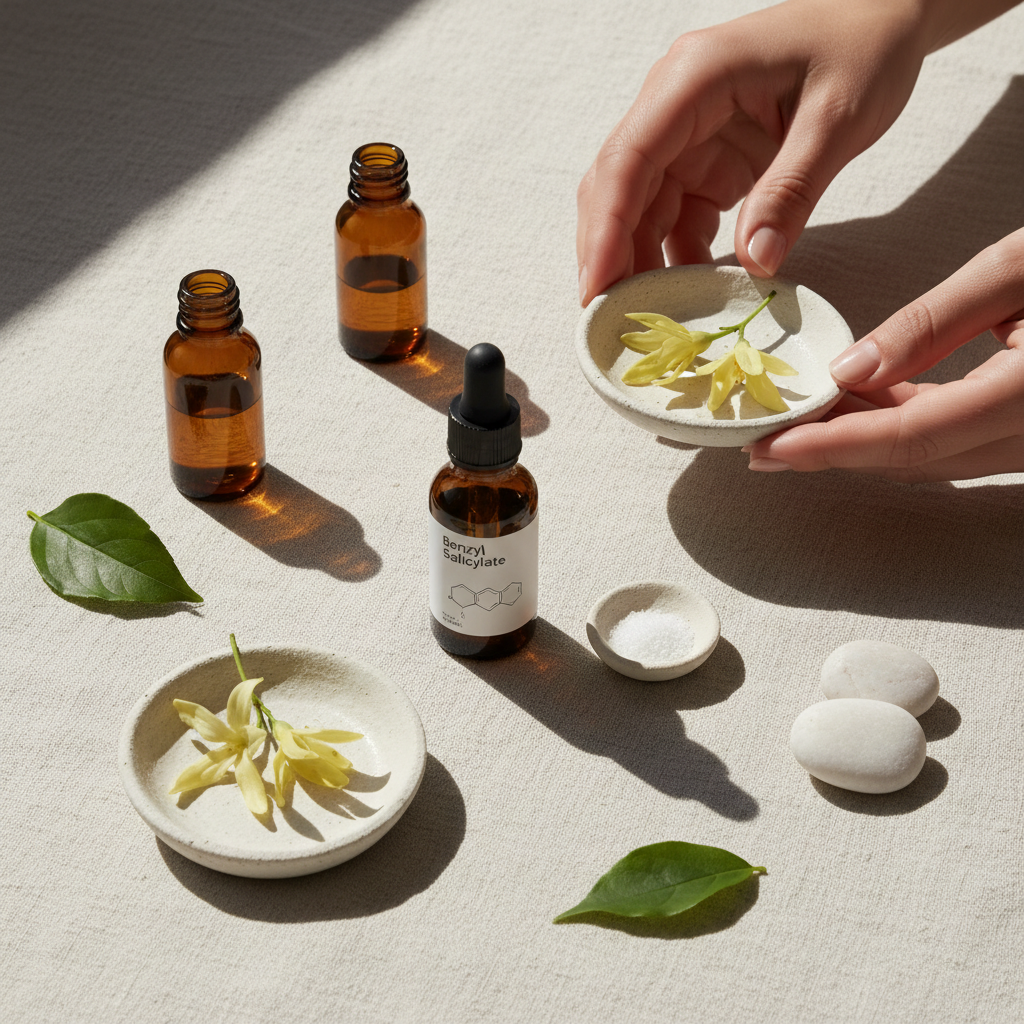
[!answer] Benzyl salicylate is a fragrance ingredient used in many cosmetics. Laboratory studies on isolated cells have shown it can exhibit weak estrogenic activity, classifying it as a potential endocrine-disrupting chemical (EDC). However, current evidence and regulatory stances suggest the low concentrations used in skincare are safe, though research into the effects of cumulative, long-term exposure is still developing.
This single compound sits at the intersection of our daily routines and a complex scientific debate about chemical safety. While laboratory findings provide a critical signal, understanding what they mean for human health requires a closer look at dosage, exposure, and the broader landscape of endocrine science.
What is benzyl salicylate and where is it found?
Benzyl salicylate is an ester of benzyl alcohol and salicylic acid, and it is one of the most common ingredients used to create and fix fragrance in personal care products. It has a mild, sweet-floral, and slightly balsamic scent that makes it a versatile component in perfumery. While it can be found naturally in the essential oils of plants like ylang-ylang and carnation, the version used in most mass-market cosmetics is typically synthesized for consistency and scale.
Its function extends beyond just scent. It acts as a solvent and a fixative, helping to dissolve other fragrance components and slow down the evaporation of the scent from the skin, making it last longer. You can find it on the ingredient lists of a vast range of products, from fine fragrances and body lotions to sunscreens, shampoos, and soaps. Its ubiquity is a key reason why its safety profile is a subject of ongoing scientific interest [5].
Does benzyl salicylate have estrogenic activity?
Yes, some laboratory evidence indicates that benzyl salicylate can have weak estrogenic activity. This means that, under specific laboratory conditions, it has been shown to interact with or modulate the body's estrogen receptors [2]. This activity is what places it in the broad category of potential endocrine-disrupting chemicals (EDCs). EDCs are substances that may interfere with the normal function of the endocrine (hormone) system.
The primary evidence for this comes from in vitro studies, which are experiments conducted on isolated cells in a petri dish. In these studies, researchers expose cells—sometimes human skin or breast cancer cells, which are often used because they are rich in estrogen receptors—to benzyl salicylate and measure the response. Some studies have found that the chemical can weakly bind to estrogen receptors and trigger a response similar to that caused by the body’s own estrogen, albeit much less potent [2].
It is crucial, however, to contextualize these findings. Observing an effect in a lab dish is not the same as predicting an effect in a living, breathing human. The concentrations used in lab studies can be much higher than what a person would absorb through their skin from a daily lotion application. Furthermore, the body has complex metabolic processes that break down and excrete substances, which are not accounted for in simple cell-based assays. So, while these studies are a vital first step in hazard identification, they are not, on their own, proof of harm.
[!quote] Growing evidence shows that endocrine disruptors chemicals (EDCs) have been considered as risk factors of infertility. Their presence in our everyday life has become ubiquitous because of their universal use in... personal care products, cosmetics... — [5]
What does "endocrine disruptor" actually mean?
An endocrine-disrupting chemical (EDC) is a substance external to the body that can interfere with the production, release, transport, metabolism, binding, action, or elimination of natural hormones. Hormones act as the body’s chemical messengers, controlling everything from growth and development to metabolism, mood, and reproduction. Because the endocrine system is so finely tuned, even small disturbances can potentially have significant physiological effects.
The concern around EDCs is centered on their ability to either mimic hormones, block them, or trigger inappropriate hormone activity. This is particularly relevant for sex hormones like estrogen and testosterone. As a group, polyphenolic compounds, which include many plant-derived and synthetic chemicals used in cosmetics, have come under scrutiny for these potential effects [2]. Other EDCs that are often discussed in the context of personal care products include certain parabens, bisphenols like BPA, and phthalates [3][4].
The scientific community is particularly interested in the effects of EDCs during sensitive life stages, such as fetal development, puberty, and pregnancy [5]. The "developmental origins of health and disease" hypothesis posits that exposure to disruptive chemicals during these critical windows can have long-lasting effects. However, establishing a direct causal link between exposure to a specific low-dose EDC and a health outcome like polycystic ovary syndrome (PCOS) or fertility issues is incredibly challenging from a research perspective [3][5].
How is benzyl salicylate regulated in cosmetics?
In major markets like the European Union, benzyl salicylate is regulated as both a fragrance ingredient and a known skin allergen. Its use is permitted in cosmetic products up to certain maximum concentrations, which are set based on risk assessments conducted by scientific bodies like the Scientific Committee on Consumer Safety (SCCS). These assessments evaluate the available toxicological data—including studies on skin absorption, irritation, and systemic toxicity—to determine a level that is considered safe for consumer use [1].
For example, the SCCS has specified maximum allowable percentages for benzyl salicylate depending on whether it's in a leave-on product (like a lotion) or a rinse-off product (like a soap). These regulations are designed to keep consumer exposure well below levels that have been found to cause adverse effects in laboratory studies. The primary regulatory focus, historically, has been on its potential to cause allergic contact dermatitis rather than its endocrine activity.
However, a key challenge in modern safety assessment, particularly in the EU where animal testing for cosmetics is banned, is evaluating the risk from aggregate exposure [1]. We are not exposed to benzyl salicylate in a vacuum; we use multiple products a day, many of which contain different potential EDCs. Understanding the cumulative "cocktail effect" of these low-dose exposures is a frontier in toxicology and regulatory science. New Approach Methodologies (NAMs), which rely on advanced computer modeling and cell-based assays, are being developed to better predict these complex human health risks without the use of animals [1].
[!quote] Despite significant progress since the ban [on animal testing] in 2013... there remains an urgent need for non-animal test methods to comprehensively assess human health risk. — [1]
What is the evidence for effects on human health?
Currently, there is no direct and conclusive evidence from human studies that demonstrates a causal link between typical exposure to benzyl salicylate from cosmetics and adverse hormonal health effects. The concerns are based on the in vitro data and the general mechanism of endocrine disruption, rather than on documented harm in the human population.
Human health investigations for chemicals like this often rely on epidemiological studies. Researchers might measure the concentration of the chemical or its metabolites in urine or blood samples from a large group of people and look for statistical correlations with certain health conditions. This has been done extensively for other EDCs like phthalates and BPA, with some studies finding associations with altered hormone levels, reproductive issues, or childhood conditions [3][4]. Similar large-scale biomonitoring studies for benzyl salicylate are less common, so the data on human exposure levels and potential health correlations is weaker.
Furthermore, adverse event reports, such as those collected by the FDA, primarily document immediate reactions like skin rashes, irritation, or allergic reactions to cosmetic products [6]. While these are important safety data, they don't typically capture long-term, systemic issues like endocrine disruption. Benzyl salicylate is recognized as a fragrance allergen, and for those who are sensitized, the risk of developing allergic contact dermatitis is a more immediate and proven concern than its potential hormonal effects.
Who should be most cautious?
While regulators consider benzyl salicylate safe at current cosmetic concentrations for the general population, certain individuals may choose to be more mindful of their exposure. The decision to avoid an ingredient is a personal one, often based on an abundance of caution rather than proven risk. Groups who might be more cautious include people with known fragrance allergies, those who are pregnant or planning a pregnancy, and parents of young children.
For individuals with sensitive skin or a history of fragrance allergies, avoiding benzyl salicylate is a practical step to prevent contact dermatitis. In the EU and some other regions, it is one of 26 fragrance allergens that must be explicitly listed on the ingredient label when present above a certain threshold, making it easier to identify and avoid.
Given the heightened sensitivity to hormonal influences during pregnancy, many experts advise minimizing exposure to all potential EDCs during this critical developmental window. As research explores the links between cumulative chemical exposures and maternal health, some expectant parents may choose to simplify their personal care routines. For a deeper dive into this topic, our article on phthalates and pregnancy offers more context on navigating EDCs. The same precautionary principle applies to infants and young children, whose developing systems are more vulnerable.
How can I avoid benzyl salicylate if I want to?
If you prefer to avoid benzyl salicylate, the most effective method is to become a diligent label reader. In most parts of the world, cosmetic ingredient lists are standardized, and you can look for "benzyl salicylate" by name. It is typically found toward the end of the ingredient list along with other fragrance components.
A simpler, though less precise, strategy is to opt for products marketed as "fragrance-free." This is a more reliable choice than "unscented," as "unscented" products may contain masking fragrances to cover the chemical smells of the base ingredients. A true fragrance-free product should contain no added fragrance materials whatsoever. Be aware, however, that even some fragrance-free products might contain plant extracts that naturally include salicylate compounds, though usually in very small amounts.
The takeaway
Benzyl salicylate is a widely used fragrance ingredient that laboratory studies have identified as a potential weak endocrine disruptor. While regulatory agencies currently consider it safe at the low concentrations found in cosmetics, the science surrounding the long-term, cumulative effects of EDCs is still evolving. For most people, the risk is likely low, but individuals with fragrance allergies or those who prefer a precautionary approach can effectively avoid it by reading ingredient labels and choosing fragrance-free products.
Sources
- [1] The way forward for assessing the human health safety of cosmetics in the EU: Proceedings of Workshop 2. — SCCS - Scientific Committee on Consumer Safety, Rogiers V, Benfenati E, Bernauer U, Bodin L, Browne P, Cabaton N, Chaudhry Q, Coenraads PJ, Corsini E, Dent M, Ellison C, Ezendam J, Gaffet E, Galli CL, Katsanou E, Koutsodimou A, Louro H, Najjar A, Paini A, Panteri E, Rousselle C, Sadekar N, Schepky A, Stępnik M, Uter W, Vanhaecke T, von Goetz N, Wijnhoven S.. 2026 · Europe PMC
- [2] An extensive review on phenolic compounds and their potential estrogenic properties on skin physiology. — Rispo F, De Negri Atanasio G, Demori I, Costa G, Marchese E, Perera-Del-Rosario S, Serrano-Candelas E, Palomino-Schätzlein M, Perata E, Robino F, Ferrari PF, Ferrando S, Letasiova S, Markus J, Zanotti-Russo M, Grasselli E.. 2023 · Europe PMC
- [3] Environmental exposure to selected non-persistent endocrine disrupting chemicals and polycystic ovary syndrome: a systematic review. — Ozga M, Jurewicz J.. 2025 · Europe PMC
- [4] Phthalates and bisphenols early-life exposure, and childhood allergic conditions: a pooled analysis of cohort studies. — Boissiere-O'Neill T, Lazarevic N, Sly PD, Ponsonby AL, Chen A, Azad MB, Braun JM, Brook JR, Burgner D, Lanphear BP, Moraes TJ, Saffery R, Subbarao P, Turvey SE, Yolton K, CHILD investigator group, BIS investigator group, Vilcins D.. 2025 · Europe PMC
- [5] Endocrine disruptor chemicals exposure and female fertility declining: from pathophysiology to epigenetic risks. — Tricotteaux-Zarqaoui S, Lahimer M, Abou Diwan M, Corona A, Candela P, Cabry R, Bach V, Khorsi-Cauet H, Benkhalifa M.. 2024 · Europe PMC
- [6] OpenFDA Cosmetic Adverse Event Report (#4). FDA Adverse Event Reporting System (2024) · OpenFDA