Guides
Finding Formaldehyde Releasers in Hair Products: A Guide
Formaldehyde releasers prevent microbial growth in hair products by slowly releasing formaldehyde. Identify them on labels to avoid potential allergic contact.
September 13, 2026
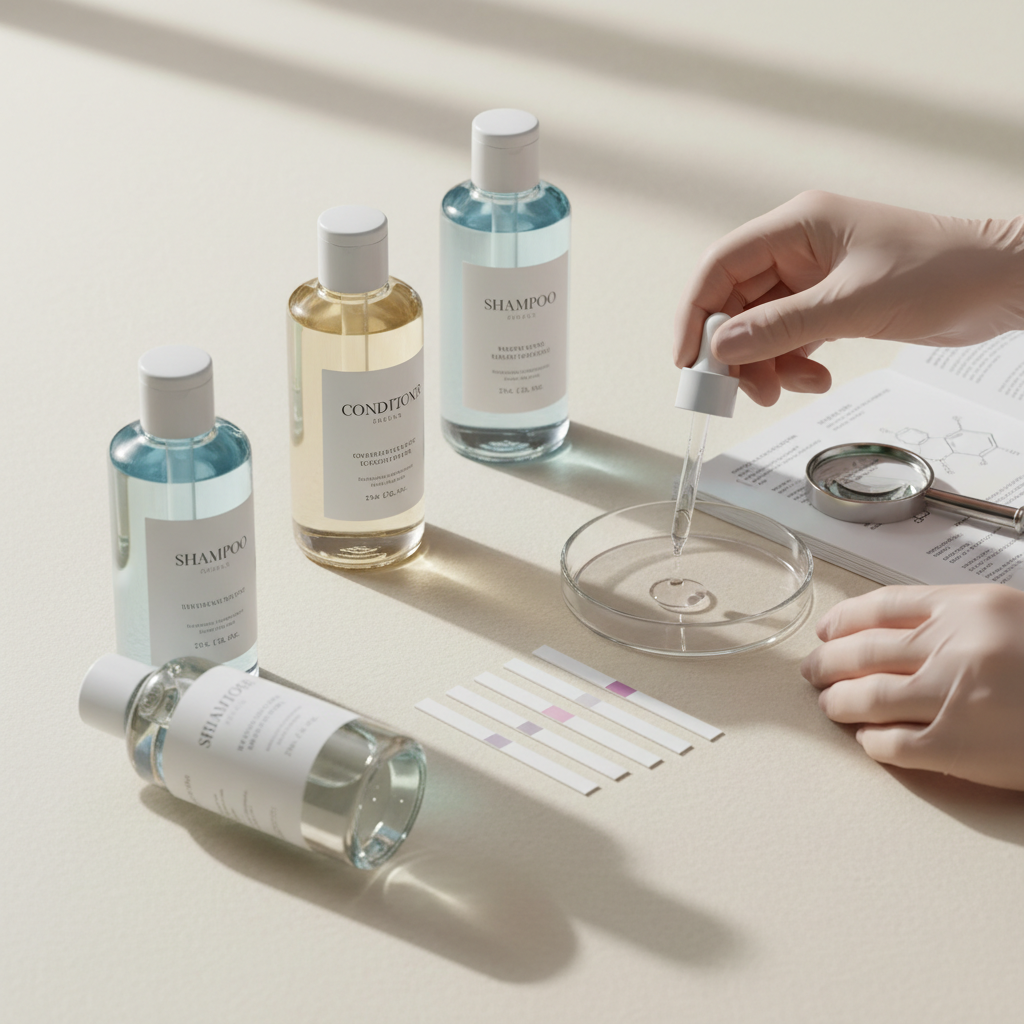
[!answer] Formaldehyde-releasing preservatives prevent microbial contamination in liquid hair products. They are not added formaldehyde, but ingredients that slowly release tiny amounts of it over time. To identify them, look for names like DMDM hydantoin, quaternium-15, diazolidinyl urea, and imidazolidinyl urea on the ingredient list.
These ingredients are some of the most effective antimicrobial agents available for water-based cosmetics, but their safety profile is complex. While regulatory bodies consider them safe at the low concentrations used in shampoos and conditioners, a growing body of evidence around skin sensitization prompts a closer look for anyone with sensitive skin or a history of contact allergies.
What are formaldehyde releasers and why are they in my shampoo?
Formaldehyde-releasing preservatives are compounds used in water-based personal care products, including shampoos, conditioners, and lotions, to prevent the growth of bacteria, yeast, and mold. Without an effective preservative system, a bottle of shampoo could become contaminated within days or weeks, posing a much more immediate health risk than the trace ingredients used to keep it clean. These ingredients don’t add free formaldehyde directly to the product. Instead, they work by decomposing slowly over time, releasing minuscule amounts of formaldehyde gas. This continuous, low-level release acts as a microcidal agent, effectively killing off any contaminants that might enter the product during manufacturing or use.
This mechanism is what makes them so efficient. Rather than a single dose of a preservative that might degrade over time, the slow-release function ensures the product remains protected throughout its shelf life. The most common formaldehyde-releasing preservatives found in hair care include DMDM hydantoin, imidazolidinyl urea, diazolidinyl urea, and quaternium-15. They have been a staple in cosmetic formulation for decades because they are broad-spectrum, stable, and cost-effective. However, their connection to formaldehyde—a chemical with a much more concerning public health profile—has made them a subject of intense scrutiny and debate among scientists and consumers alike.
Are these ingredients the same thing as formaldehyde?
No, and this distinction is critical. An ingredient like quaternium-15 is a distinct chemical entity from formaldehyde itself. The controversy stems from the fact that its function involves formaldehyde. Think of it as a delivery system. The product on the shelf contains the "releaser" molecule, not a solution of formaldehyde. It’s only under specific conditions (in this case, suspended in a water-based liquid) that the releaser molecule breaks down and lets go of a formaldehyde molecule.
The amount of formaldehyde released is extremely small, typically measured in parts per million (ppm). Cosmetic regulators in the US and Europe cap the concentration of these releasers to ensure that the amount of free formaldehyde present stays well below established safety thresholds—usually under 0.2% (2000 ppm) for the total formulation, with the actual released amount being far lower. This is a starkly different scenario from the high concentrations of formaldehyde found in some professional hair smoothing or keratin treatments, which have been the subject of significant health warnings due to the release of formaldehyde gas into the air during the heating process. In rinse-off products like shampoo, the exposure is both minimal and brief.
What is the primary health concern?
The most well-documented and widely accepted health risk associated with formaldehyde-releasing preservatives is allergic contact dermatitis [2]. Formaldehyde is a known skin sensitizer. While many people can use products containing these ingredients for years with no issue, repeated exposure can trigger an allergic reaction in susceptible individuals. This is not an immediate irritation but a type IV hypersensitivity reaction, meaning the immune system becomes sensitized to the chemical. Once you are sensitized to formaldehyde, any future exposure—even to the tiny amounts released from a preservative—can cause a flare-up of dermatitis, characterized by redness, itching, scaling, and sometimes blisters.
Quaternium-15 was once a leading cause of preservative-related contact dermatitis, and its prevalence has led many brands to formulate away from it. However, other releasers like DMDM hydantoin and diazolidinyl urea can still pose a risk for those who are already sensitized. Some individuals who are allergic to formaldehyde itself can tolerate some releasers but not others, depending on the rate and amount of formaldehyde they release. According to a major European review on contact allergens, formaldehyde remains a significant public health concern, with sensitization often stemming from sources in cosmetics and personal care products [2]. For people with eczema or generally sensitive skin, avoiding these ingredients is a practical step toward minimizing potential flare-ups.
[!quote] The use of synthetic, chemical-based cosmetics are exposed to significantly higher risks than those opting for natural alternatives. The use of synthetic products has been associated with a variety of chronic diseases. — [1]
What does the research say about cancer risk?
This is where the conversation requires the most nuance. Formaldehyde is classified as a known human carcinogen by the International Agency for Research on Cancer (IARC) and the National Toxicology Program. However, this classification is based primarily on high-dose, long-term inhalation exposure, such as that experienced by industrial workers and embalmers [1]. The risk is associated with formaldehyde gas being breathed into the lungs. The key question for cosmetics is whether the tiny amount of formaldehyde released by preservatives and absorbed through the skin poses a similar risk.
Currently, major regulatory bodies, including the US Food and Drug Administration (FDA) and the European Commission’s Scientific Committee on Consumer Safety (SCCS), permit the use of formaldehyde releasers at low, specified concentrations. The consensus in the regulatory toxicology community is that the levels of formaldehyde released in this context are too low to pose a cancer risk. The skin itself also provides a barrier, and much of the product is rinsed off in the case of a shampoo or conditioner, limiting total exposure.
That said, some researchers express concern not about single products, but about cumulative exposure from the many different products a person may use daily over a lifetime [1]. This "aggregate exposure" model is a growing area of scientific interest. While the evidence does not support a direct link between the use of a shampoo with DMDM hydantoin and cancer, the conversation reflects a broader shift toward understanding the long-term effects of low-dose chemical exposures from many sources. For consumers, this means weighing the established regulatory opinion against a personal desire to minimize exposure to controversial chemicals.
How can I find formaldehyde releasers on a label?
Identifying formaldehyde-releasing preservatives requires a careful read of the INCI (International Nomenclature of Cosmetic Ingredients) list on the back of the bottle. They are never listed as "formaldehyde." Instead, you must look for their specific chemical names. Being familiar with these names is the most reliable way to make an informed choice. It is also a key skill if you are trying to avoid known triggers for skin reactions.
Here are the most common formaldehyde-releasing preservatives to look for:
- DMDM Hydantoin
- Quaternium-15 (now less common due to high rates of allergy)
- Diazolidinyl Urea
- Imidazolidinyl Urea
- Polyoxymethylene Urea
- Sodium Hydroxymethylglycinate
- 2-Bromo-2-Nitropropane-1,3-Diol (also known as Bronopol)
- 5-Bromo-5-Nitro-1,3-Dioxane (also known as Bronidox)
If you see any of these names on an ingredient list, the product contains a formaldehyde-releasing preservative. Some brands may use marketing language like "formaldehyde-free," but the only way to be certain is to check the INCI list for these specific ingredients.
What are the alternatives?
Fortunately, there are many effective alternatives that formulators can use to keep products safe and free of contamination. As consumer demand for products without formaldehyde releasers has grown, brands have invested heavily in alternative preservative systems. When you look at a product that is "free of formaldehyde releasers," you will likely find one or more of these common alternatives on its ingredient list.
Common alternatives include:
- Phenoxyethanol: A widely used, effective broad-spectrum preservative. Though it has its own minor controversies, it is not a formaldehyde releaser and is considered safe at current concentrations by regulators worldwide. For more detail, you can explore the science on its absorption and safety.
- Sodium Benzoate and Potassium Sorbate: These food-grade preservatives are often used together to protect against a wide range of microbes.
- Caprylyl Glycol, Ethylhexylglycerin: These are often used as part of a "preservative-free" system, where they act as potentiators that boost the efficacy of other antimicrobial agents.
- Parabens (e.g., Methylparaben, Propylparaben): While also a subject of debate, particularly regarding endocrine disruption, parabens do not release formaldehyde and are extremely effective preservatives.
Another approach is to formulate products without water (anhydrous formulas) or to design packaging that minimizes contamination, though this is less common for liquid shampoos. Knowing a product's shelf life is also important; cosmetic shelf life symbols like the Period After Opening (PAO) icon can help you understand how long a specific preservative system is designed to work.
[!quote] Contact allergy (sensitisation) and allergic contact dermatitis (ACD) resulting from it have a considerable public health impact. — [2]
The takeaway
Formaldehyde-releasing preservatives are effective at keeping hair care products safe from microbial growth, but they are also a known cause of allergic contact dermatitis. While regulators deem them safe at low concentrations, individuals with sensitive skin or a known allergy to formaldehyde should check ingredient labels for names like DMDM hydantoin and choose products with alternative preservatives. Ultimately, understanding your own skin's sensitivity and learning how to read an ingredient list is the best way to navigate this complex topic.
Sources
- [1] The dark side of beauty: an in-depth analysis of the health hazards and toxicological impact of synthetic cosmetics and personal care products. — Alnuqaydan AM.. 2024 · Europe PMC
- [2] Contact Allergy-Emerging Allergens and Public Health Impact. — Uter W, Werfel T, Lepoittevin JP, White IR.. 2020 · Europe PMC