Guides
How to Verify Organic & Natural Cosmetic Certifications
Unregulated terms like "natural" and "organic" make cosmetic shopping confusing. Verify claims by checking for third-party seals like USDA, NSF, and COSMOS.
May 7, 2026
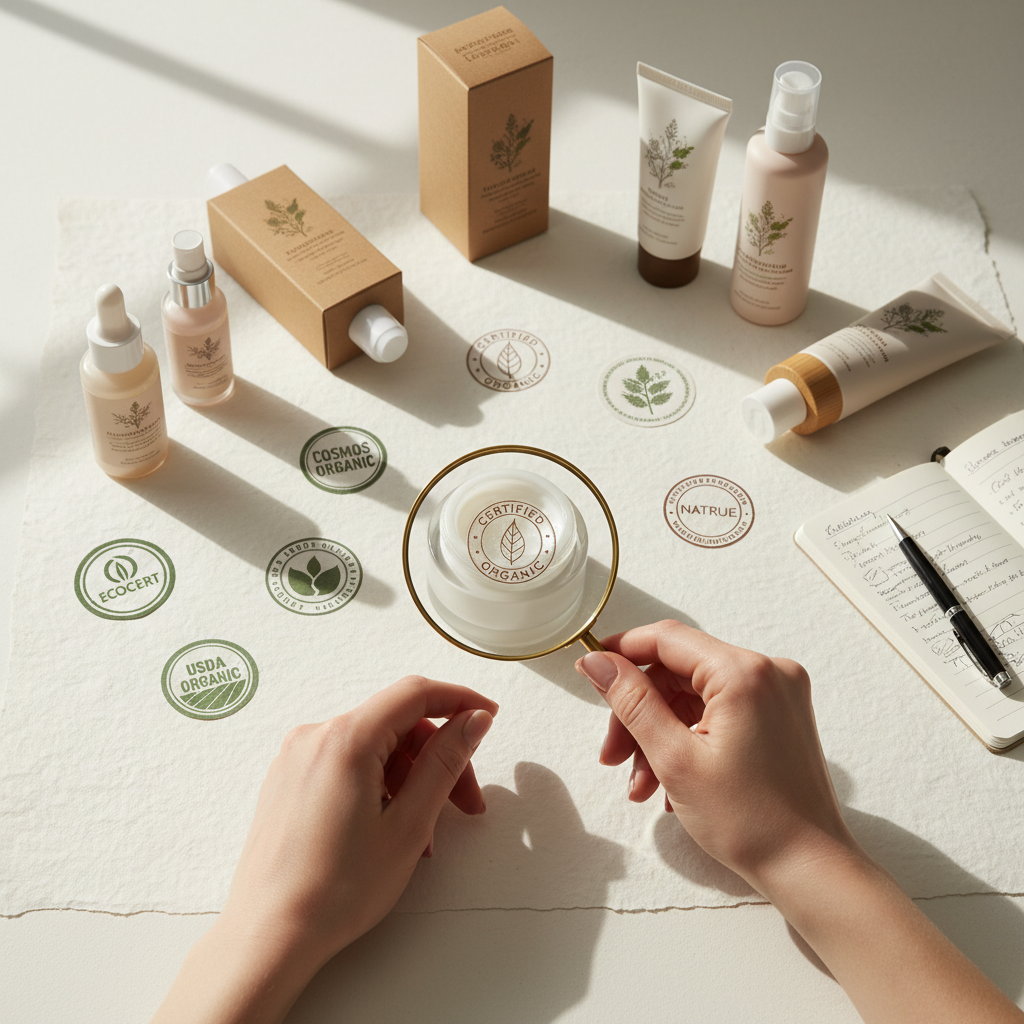
[!answer] The terms "natural" and "organic" are not legally defined for cosmetics in the US, leading to potential greenwashing. To verify a product's claim, ignore unregulated marketing terms and look for official third-party certification seals like USDA Organic, NSF, COSMOS, or NATRUE. The most reliable step is to then confirm the product or brand is listed in that certifier's public online database.
The beauty aisle is filled with earthy tones, leafy logos, and reassuring claims like "natural," "organic," and "clean." But in an industry where these terms lack firm legal definitions, how can we know what we're actually buying? This guide provides a clear, step-by-step process for cutting through the marketing clutter and verifying these claims for yourself.
What do "natural" and "organic" actually mean on a cosmetic label?
On their own, these terms mean very little. The FDA has not established a formal definition for "natural" or "organic" as they apply to cosmetic products [5]. Unlike the strict regulations for organic food, the cosmetic landscape is more like the Wild West. This lack of a legal standard allows for significant "greenwashing," where brands use an eco-friendly image to suggest a product is healthier or more ethical than it actually is.
A product with a single plant-derived ingredient can legally be marketed as "natural," even if the rest of its formula is composed of synthetic chemicals. Similarly, a product can be called "organic" even if it contains only a small percentage of certified organic ingredients alongside non-organic ones. These terms are primarily marketing tools, and without a certification seal from an independent body, they are not reliable indicators of a product's composition or sourcing [1].
Why isn't the FDA regulating these labels?
The FDA's role in cosmetic oversight is fundamentally different from its role with food or drugs. Under the Federal Food, Drug, and Cosmetic Act, the FDA's primary mandate for cosmetics is to ensure they are not "adulterated" or "misbranded." Their focus is on safety—addressing harmful ingredients, contamination, and false safety claims—rather than verifying marketing language like "natural." The agency receives thousands of cosmetic adverse event reports, which can include issues from mild skin irritation to more severe reactions, and its resources are often directed toward immediate public health concerns [6][7].
While the FDA can take action against a brand for making misleading claims, policing the nuance of "natural" is a lower priority and a significant challenge. The term is inherently ambiguous. Does "natural" mean it comes from a plant, or that it’s processed without chemicals? What about ingredients derived from natural sources but synthesized in a lab for purity? Because there is no consensus, the FDA leaves this space largely to third-party certifiers and consumer discretion, focusing its limited resources on more urgent safety issues [8].
[!quote] Certification isn't about guaranteeing a product is 'safe' for everyone; it's about providing third-party verification for claims about how its ingredients were grown and processed. — [4]
What are the main certifications I should look for?
Instead of relying on a product's self-proclaimed status, look for logos from reputable, independent organizations that have developed their own stringent standards. These certifiers audit not just the final product, but the entire supply chain.
Here are the most common and trustworthy certifications you’ll encounter:
USDA Organic: This seal is one of the most recognized. Because the USDA’s purview is agriculture, this certification applies to the farm-sourced ingredients in a product. It has several tiers: "100% Organic" (all ingredients are organic), "Organic" (at least 95% organic ingredients), and "Made with Organic Ingredients" (at least 70% organic ingredients). The latter cannot use the USDA seal on the front of the packaging but can list certified ingredients on the information panel.
NSF/ANSI 305: Developed because the USDA food standard wasn’t a perfect fit for complex cosmetic formulations, the NSF "Made with Organic Ingredients" standard is a specific framework for personal care. Products bearing this mark must contain at least 70% certified organic ingredients and meet strict requirements for processing and ingredient sourcing. It’s a robust standard tailored to the realities of creating functional products like lotions and shampoos [2].
COSMOS (Cosmetic Organic Standard): This is a harmonized European standard that incorporates several earlier certifiers, including ECOCERT (France), BDIH (Germany), and the Soil Association (UK). It is one of the most rigorous standards globally. It has two main signature types: "COSMOS Organic" requires that at least 95% of the product's plant-based ingredients are organic and at least 20% of the total product by weight is organic. "COSMOS Natural" doesn't have a minimum organic percentage but ensures ingredients are from natural origin and processed according to strict green chemistry principles.
NATRUE: Another stringent European-based certifier, NATRUE focuses on ensuring products are as natural as possible. It forbids things like synthetic fragrances, silicones, and petroleum-derived ingredients. NATRUE has three levels of certification: Natural Cosmetics, Natural Cosmetics with an Organic Portion (at least 70% of natural ingredients are organic), and Organic Cosmetics (at least 95% of natural ingredients are organic).
How can I verify a certification is real?
Unfortunately, some brands have been known to use fake or look-alike logos to mislead customers. Simply seeing a seal on a bottle is not always enough. The single most effective way to confirm a product’s status is to check the certifier’s own public database.
Here is a simple, four-step process:
- Identify the logo. Look at the product packaging and determine which certification it claims to have (e.g., COSMOS, NATRUE, NSF).
- Go to the certifier’s official website. A quick web search for "COSMOS certified product database" or "USDA Organic Integrity Database" will lead you to the right place.
- Search for the brand or product. These databases are publicly searchable. You can type in the brand name (e.g., "ElysiNexa Botanicals") or sometimes the specific product name to see if it appears.
- Confirm the status. If the brand or product is listed, you can be confident the certification is legitimate. If it’s not there, the claim on the packaging may be expired, fraudulent, or apply to a different product from the same brand [3]. This check takes less than a minute and is the only way to be absolutely sure.
Are certified "natural" products automatically safer?
No. Certification is about transparency, sourcing, and processing—not a guarantee of universal safety or hypoallergenicity. Natural ingredients can be powerful, and some can be irritating or cause allergic reactions depending on the individual. Many potent allergens are 100% natural; poison ivy is a classic example.
Essential oils and other plant extracts used for fragrance are a common source of sensitivity. For instance, many natural fragrance components, like benzyl salicylate, are known contact allergens for a segment of the population. Just because an ingredient is grown on an organic farm doesn't mean it can't cause a reaction on your specific skin. Safety is always personal. Certification tells you how it was made, not how your body will react to it.
What about unregulated terms like "clean" or "non-toxic?"
Terms like "clean," "green," "eco-friendly," and "non-toxic" are purely marketing buzzwords with no standardized or legal definition. They have even less meaning than "natural" because they aren't even associated with a specific type of ingredient. These labels are typically defined by a brand or a retailer (like "Clean at Sephora") based on their own internal list of "unacceptable" ingredients.
While these programs can be a helpful filter for consumers looking to avoid certain substances, their criteria can vary wildly from one retailer to another. One store’s "clean" standard might ban sulfates, while another’s might allow them but ban parabens. These lists are not based on a regulatory consensus and can change at any time. Think of them as a brand’s philosophy, not as a scientific or certified claim.
The takeaway
Navigating the world of natural cosmetics requires a discerning eye. Instead of being swayed by vague marketing terms on the front of the bottle, turn it over and look for a reputable, third-party certification seal. For ultimate peace of mind, take the final step and verify that certification in the organization
Sources
- [1] XII National Congress SISMES Padua, 8–10 October, 2021. 2021 · Europe PMC
- [2] Abstracts from the 2021 Annual Meeting of the Society of General Internal Medicine.. 2021 · Europe PMC
- [3] Program Abstracts from The GSA 2021 Annual Scientific Meeting, "Disruption to Transformation: Aging in the "New Normal"".. 2021 · Europe PMC
- [4] ECR 2019: Book of Abstracts : Vienna, Austria. February 27 - March 3, 2019.. 2019 · Europe PMC
- [5] OpenFDA Cosmetic Adverse Event Report (#1). FDA Adverse Event Reporting System (2025) · OpenFDA
- [6] OpenFDA Cosmetic Adverse Event Report (#2). FDA Adverse Event Reporting System (2025) · OpenFDA
- [7] OpenFDA Cosmetic Adverse Event Report (#3). FDA Adverse Event Reporting System (2024) · OpenFDA
- [8] OpenFDA Cosmetic Adverse Event Report (#4). FDA Adverse Event Reporting System (2024) · OpenFDA