Ingredients
Octocrylene Safety: The Science on Degradation & Absorption
Octocrylene in sunscreen can degrade into benzophenone, a potential endocrine disruptor. Regulators consider it safe at approved levels for most people.
August 2, 2026
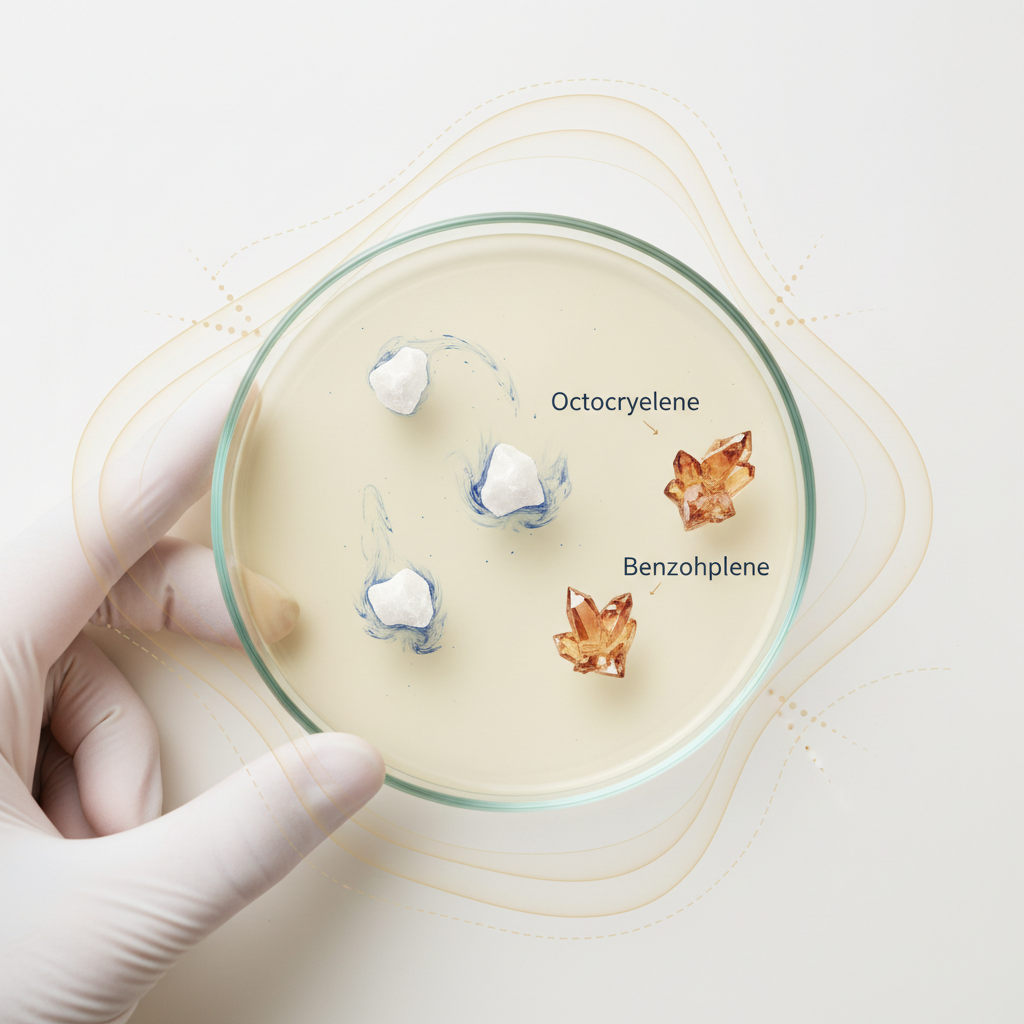
[!answer] Octocrylene is a UV filter that protects against UVB rays and stabilizes other sunscreen ingredients. It can degrade into benzophenone, a compound with potential endocrine-disrupting effects. While under review, regulators in the US and EU currently consider octocrylene safe for use in sunscreens at approved concentrations.
Octocrylene is one of the most common ingredients in chemical sunscreens, valued for its ability to protect our skin. Yet, it has become the subject of intense debate, centered on its tendency to break down over time and its potential to be absorbed by the body. This article unpacks the science behind the headlines, examining the evidence on octocrylene degradation, systemic absorption, and what it all means for your daily sunscreen choice.
What is octocrylene, and why is it in my sunscreen?
Octocrylene is an organic compound used as a chemical UV filter in sunscreens and other personal care products with SPF, like lip balms and moisturizers. Its primary job is to absorb ultraviolet (UV) radiation, specifically in the UVB and, to a lesser extent, UVA-II range. By absorbing these rays, it converts the energy into a small amount of heat, preventing the radiation from damaging skin cells, which can lead to sunburn, premature aging, and skin cancer.
Beyond its own UV-blocking capabilities, octocrylene plays a crucial secondary role: it is an excellent photostabilizer. Many highly effective UV filters, most notably avobenzone (a gold-standard UVA filter), are notoriously unstable in sunlight. When exposed to UV radiation, they quickly degrade and lose their protective ability. Octocrylene helps to stabilize these more fragile ingredients, ensuring that the sunscreen maintains its stated SPF and broad-spectrum protection for a longer period of time on your skin.
This dual functionality—acting as both a filter and a stabilizer—has made octocrylene an incredibly popular and effective ingredient for formulators. It allows for sunscreens that are cosmetically elegant (i.e., not thick and white), long-lasting, and highly protective. However, the chemistry of octocrylene itself is also the source of the recent concerns.
What is the concern about octocrylene degradation?
The primary concern surrounding octocrylene is its potential to degrade over time into a different chemical: benzophenone. This is not a rapid process that happens on the skin immediately upon application, but rather a slow degradation that can occur in the product bottle, particularly in older products or those stored improperly. When octocrylene breaks down, it can undergo a process called a retro-Aldol condensation, yielding benzophenone as a contaminant.
The presence of benzophenone is significant because it belongs to a class of chemicals that has been flagged for potential health risks. A comprehensive 2024 review of the last decade of research highlighted ongoing concerns about the endocrine-disrupting effects of benzophenone derivatives [1]. While many different benzophenones exist, the family as a whole has been a focus of scientific scrutiny.
This degradation raises two key questions that researchers are actively investigating. First, how much benzophenone is actually formed in a typical sunscreen product over its shelf life? And second, is that amount significant enough to pose a health risk? This uncertainty is at the heart of the debate, separating the theoretical risk of a chemical reaction from the actual, real-world risk to a person using the product as intended.
What does the research say about benzophenone's effects?
Benzophenone and its derivatives, like benzophenone-3 (more commonly known as oxybenzone), have been studied for their ability to interact with the body's hormonal systems. Research has established that some of these compounds can act as endocrine disruptors, meaning they can mimic or interfere with the body's natural hormones, particularly estrogen [1].
Most of this evidence comes from laboratory (in vitro) and animal studies. These studies often use concentrations of the chemical that are far higher than what a human would be exposed to through sunscreen use. However, they are a critical tool for identifying potential hazards. The recent decade of research has solidified the view that benzophenone derivatives can have endocrine-disrupting properties, prompting regulators to keep them under close review [1].
The crucial distinction is between a hazard (a substance's potential to cause harm) and a risk (the likelihood of that harm occurring under specific conditions of exposure). While benzophenone is considered a potential endocrine hazard, the risk to humans from the trace amounts that might form in an aging sunscreen product is less clear and is the subject of ongoing scientific and regulatory debate [2].
[!quote] While UV filters are empirically effective, allegations about their effects range from scientifically-backed concerns to myths that require a more differentiated look. — [2]
Does octocrylene get absorbed through the skin?
Yes, small amounts of octocrylene can be absorbed through the skin and enter the bloodstream. This is not unique to octocrylene; a number of common chemical UV filters have been shown to be systemically absorbed after topical application. The FDA has acknowledged this, leading to a call for more research on the potential long-term effects of this low-level exposure. You can read more about this in our broader guide to chemical sunscreen absorption.
Octocrylene is a lipophilic (oil-soluble) compound. Research has shown that UV irradiation of the skin can actually increase the absorption of certain lipophilic compounds, though the exact mechanisms are complex [3]. This means that the very act of being in the sun while wearing sunscreen could theoretically influence how much of the ingredient is absorbed.
However, it is vital to keep the quantities in perspective. The amount of octocrylene detected in blood plasma during sunscreen studies is typically very low—measured in nanograms per milliliter (ng/mL). The key question for regulators and toxicologists is whether this low-level systemic exposure is significant enough to have any biological effect, a question that applies to many sunscreen ingredients under review.
If octocrylene is absorbed, what happens to it in the body?
Once a substance like octocrylene is absorbed into the bloodstream, it doesn’t simply accumulate indefinitely. The body has sophisticated systems, primarily in the liver, for metabolizing and eliminating foreign chemicals. Scientists study this process to understand a compound's safety profile.
Recent research using human liver microsomes helps predict how octocrylene is metabolized. An in vitro-in vivo extrapolation approach allows scientists to use data from lab tests to model what will happen in the human body [4]. This research indicates that the liver breaks down octocrylene into other compounds that can then be excreted from the body, primarily in urine.
This metabolic process is a key part of the body's defense against chemical exposures. It reduces the concentration and residence time of the original chemical in the bloodstream, limiting its potential to interact with other systems in the body. Understanding the speed and efficiency of this process is essential for conducting an accurate risk assessment for any chemical, including UV filters.
What do regulators say about octocrylene's safety?
Regulatory bodies around the world, including the FDA in the United States and the Scientific Committee on Consumer Safety (SCCS) in the European Union, have reviewed the evidence on octocrylene extensively. Their current consensus is that octocrylene is safe for use in sunscreens at the concentrations currently permitted—up to 10% in both the US and EU.
These agencies are aware of both the degradation and absorption issues. Their safety assessments are based on the totality of the evidence, which weighs the potential risks against the proven and significant benefits of using sunscreen to prevent skin cancer [2]. They acknowledge the endocrine-disrupting potential seen in lab studies but have so far concluded that the low levels of exposure from proper sunscreen use do not pose a known risk to human health.
That said, the science is not static. Both the FDA and SCCS continue to monitor new research on UV filters. The conversation around octocrylene has prompted a re-evaluation of data, and these official positions could change if new evidence emerges to suggest that the risks are greater than previously understood. For now, the ingredient remains an approved and essential tool in the fight against UV damage.
How can I use sunscreen safely and effectively?
Given the evidence, a few practical steps can help you navigate the sunscreen aisle with confidence. The degradation of octocrylene into benzophenone is a process that happens over time, making a product's age the most significant factor.
First and foremost, never use expired sunscreen. The expiration date on the package is the single best guide to its stability and efficacy. If a product doesn't have an expiration date, look for the Period After Opening (PAO) symbol—a small icon of an open jar with a number like "12M" or "24M" inside. This tells you how many months the product remains safe and effective after you first open it. You can learn more in our guide to cosmetic shelf life symbols.
Second, store your sunscreen properly. Heat and sunlight can accelerate the degradation of active ingredients. Keep your sunscreen in a cool, dark place whenever possible. Avoid leaving it in a hot car or in direct sunlight on the beach for extended periods.
Finally, if the ongoing scientific debate about octocrylene is a concern for you, there are countless effective alternatives. You can choose a mineral-based sunscreen with zinc oxide and/or titanium dioxide as the active ingredients. These work by sitting on top of the skin and physically blocking UV rays, and they are not associated with systemic absorption or hormonal concerns. You can also look for octocrylene-free chemical sunscreens, as many brands now formulate with other combinations of UV filters.
The takeaway
The proven benefit of sunscreen in preventing skin cancer is undisputed. While octocrylene is under scientific scrutiny for its potential to degrade and be absorbed by the body, current regulatory consensus finds it safe at approved levels. Consumers who feel concerned have many excellent octocrylene-free alternatives, including mineral-based formulas and different chemical filter combinations.
Sources
- [1] Endocrine and Reproductive Health Considerations of Sunscreen UV Filters: Insights from a Comprehensive Review 2014-2024. — Jaskulak M, Cinkusz M, Franchuk K, Zorena K.. 2025 · Europe PMC
- [2] Ultraviolet Filters: Dissecting Current Facts and Myths. — Breakell T, Kowalski I, Foerster Y, Kramer R, Erdmann M, Berking C, Heppt MV.. 2024 · Europe PMC
- [3] Irradiation of skin and contrasting effects on absorption of hydrophilic and lipophilic compounds. — Duracher L, Blasco L, Abdel Jaoued A. Photochemistry and photobiology (2009) · PubMed
- [4] Assessing the hepatic metabolism of six sunscreen ultraviolet filters: In vitro-in vivo extrapolation approach using human liver microsomes and hepatic parameter predictions for exposure risk assessment. — Baviera GS, Poli VR, Oka-Duarte L. Biochemical pharmacology (2026) · PubMed