Ingredients
PFAS in Waterproof Makeup: A Guide to Forever Chemicals
PFAS in waterproof makeup offer smoothing and water resistance, but these "forever chemicals" raise significant health concerns due to their persistence.
May 25, 2026
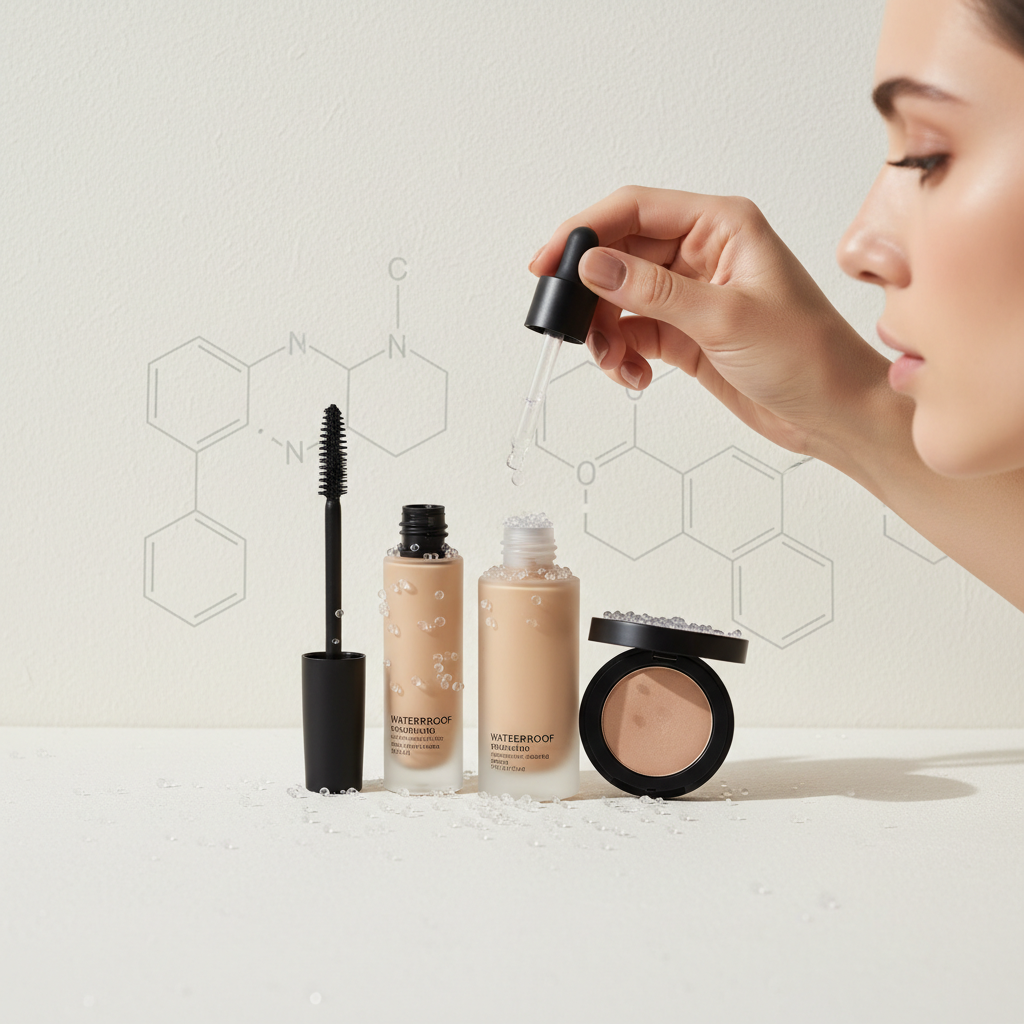
[!answer] Per- and polyfluoroalkyl substances (PFAS) are a class of chemicals intentionally used in some long-wear and waterproof cosmetics to provide water resistance, staying power, and a smooth finish. Research is currently focused on developing reliable methods to detect and quantify these "forever chemicals" in complex product formulations like mascara, an essential step toward understanding consumer exposure from cosmetics. [1]
These chemicals are prized for their endurance, the very quality that gives your waterproof mascara its tenacity. Yet the term "forever chemicals" hints at a permanence that extends far beyond a 16-hour wear time, raising important questions about the products we apply to our skin every day.
What are PFAS, and why are they in my mascara?
Per- and polyfluoroalkyl substances (PFAS) are a large family of thousands of synthetic chemicals known for their remarkable ability to repel both oil and water. This dual resistance comes from their molecular structure: a backbone of carbon atoms bonded to fluorine atoms, creating one of the strongest bonds in organic chemistry. This bond makes them incredibly stable and resistant to heat, grease, and water, which is why they are used in everything from non-stick cookware and stain-resistant carpets to firefighting foam.
In the world of cosmetics, these same properties are highly valued for performance. Manufacturers intentionally add certain PFAS to products to act as emulsifiers, surfactants, and stabilizers, helping to create a uniform and stable formula [1]. Their primary function is to form a smooth, resilient film on the skin or eyelashes. This is what gives waterproof mascara its ability to withstand rain or tears, long-wear foundation its staying power, and some powders their silky, smooth-gliding texture. Essentially, when you see a cosmetic product that promises exceptional longevity and resistance to the elements, there's a chance PFAS are part of the formulation strategy.
While their use is functional, the conversation around PFAS has shifted. What was once purely a discussion of chemical performance has become a subject of environmental and health scrutiny. Because the carbon-fluorine bond is so strong, these chemicals do not easily break down in the environment or in our bodies, earning them the moniker "forever chemicals." Their persistence is the very reason they are now under a scientific microscope.
How do these 'forever chemicals' work in cosmetics?
The role of PFAS in a cosmetic formula is subtle but powerful. As surfactants and emulsifiers, they help blend ingredients that would naturally separate, like oil and water, ensuring a smooth, consistent product from the first application to the last [1]. This stabilization is key for creating the textures consumers have come to expect from high-performance makeup.
When applied, the PFAS ingredients contribute to the formation of a flexible, invisible film. This film acts as a shield against moisture and oils, which are the two main culprits in makeup degradation. For a mascara, this means preventing smudging or running when exposed to sweat, humidity, or tears. For a liquid lipstick or foundation, it provides a transfer-resistant finish that can last for many hours without needing reapplication. The result is a product that delivers on its promise of long-lasting, waterproof wear.
This performance comes from the unique chemistry of PFAS. The fluorinated part of the molecule is hydrophobic (water-repelling) and lipophobic (oil-repelling), creating a low-energy surface that causes liquids to bead up and roll off rather than being absorbed. It’s the same principle that makes a high-quality raincoat effective, but miniaturized and applied to your lashes or lips.
What does the latest research say about PFAS in makeup?
The scientific community is actively working to understand the presence of PFAS in cosmetics, but it's a relatively new area of focus. Historically, as one recent study notes, research efforts have been concentrated on detecting these chemicals in environmental samples like water, air, and soil [1]. The investigation of PFAS in complex consumer goods like personal care products is a more recent, and more complicated, endeavor. Studies have confirmed their presence in products like foundation, powders, and nail polish, but the picture is far from complete [1].
One of the biggest takeaways from current research is that we are still in the foundational stages of understanding this issue. A 2025 study on PFAS in mascara, for instance, wasn't about determining health effects, but about a more fundamental problem: figuring out the best way to even measure them accurately [1]. This highlights a critical point: before we can assess the risk, we need reliable methods to quantify what’s actually in the bottle.
This work is crucial because it paves the way for all future research. By developing and validating new analytical techniques, scientists can build a more accurate database of which PFAS are used, in which products, and at what concentrations. This data will be essential for regulators to create effective policies and for toxicologists to conduct meaningful safety assessments.
[!quote] The complexity of cosmetic formulations, with various additives, makes the analysis of these samples extremely challenging. — [1]
Why is it so hard to study PFAS in makeup?
Studying PFAS in cosmetics is not as simple as running a product through a single machine. The very nature of a cosmetic formulation—a complex mixture of oils, waxes, pigments, preservatives, and other chemicals—makes it difficult to isolate and measure one specific class of ingredients accurately. As the authors of the mascara study state, "the complexity of cosmetic formulations, with various additives, makes the analysis of these samples extremely challenging" [1].
The challenge lies in extraction. To measure PFAS, scientists must first pull them out of the product matrix while leaving all the other ingredients behind. The 2025 study mentioned earlier compared two advanced methods—solid-phase microextraction (SPME) and micro-solid phase extraction (µSPE)—to see which was more effective for analyzing mascara [1]. The fact that analytical chemists are publishing papers on extraction efficiency tells you that the science is still at a very early stage. It’s akin to perfecting the tools you need before you can begin to build the house.
This complexity is a significant hurdle for researchers, regulators, and brands alike. It means that screening products for PFAS is a resource-intensive and highly specialized task. It also means that contamination or the presence of impurities can be difficult to rule out. Until these analytical methods become more standardized and accessible, a comprehensive market-wide survey of PFAS in cosmetics remains a major undertaking.
Could cosmetic PFAS exposure pose a health risk?
This is the central question, and at present, there is no definitive answer specifically for cosmetic use. The available sources for this article do not provide evidence linking PFAS in makeup to specific health outcomes. The concern surrounding PFAS largely stems from a much broader body of research on environmental exposure—primarily through contaminated drinking water and food—which has associated high levels of certain PFAS with a range of health issues, including immune system effects, liver damage, and an increased risk of some cancers.
Because some PFAS have been shown to have endocrine-disrupting properties in laboratory and environmental studies, their intentional use in cosmetics has drawn scrutiny. The skin is our largest organ, and while it acts as a barrier, some chemicals can be absorbed, particularly with daily, long-term application. The question of whether PFAS from a lipstick or foundation can be absorbed and contribute to the body's total load of these chemicals is a critical one that researchers are working to answer. If you are interested in learning more about how to identify these types of ingredients, ElysiNexa has a comprehensive guide to spotting endocrine disruptors on product labels.
The challenge is extrapolating from high-dose environmental studies to the low-dose, direct application scenario of cosmetics. It’s an open question and an area where more research is urgently needed. For now, the scientific community is focused on the first step: identifying what’s there. Understanding the long-term health implications will be the next chapter.
How can I tell if a product contains PFAS?
If you prefer to avoid PFAS in your cosmetics, the best tool you have is the ingredient list (often labeled as INCI, or International Nomenclature of Cosmetic Ingredients). Manufacturers are required to list all intentionally added ingredients.
Look for ingredients that have "perfluoro" or "polyfluoro" in their name. Some of the most common PFAS-related ingredients you might find on a label include:
- Polytetrafluoroethylene (PTFE)
- Perfluorononyl Dimethicone
- Perfluorodecalin
- C9-15 Fluoroalcohol Phosphate
- Octafluoropentyl Methacrylate
Reading labels is the most direct way to make an informed choice. However, it’s important to note that this only covers intentionally added ingredients. The issue of trace contaminants or impurities from raw materials is a separate, more complex challenge that is harder for consumers to identify. For those who wish to be cautious, choosing products from brands that are transparent about their sourcing and testing, or that explicitly market themselves as "PFAS-free," can provide an additional layer of assurance.
The takeaway
PFAS are intentionally used in some waterproof and long-wear cosmetics to enhance performance, creating the durable, smooth finish many consumers value. The science of detecting these "forever chemicals" in complex cosmetic formulas is still evolving, which is the first step toward understanding exposure and any potential long-term effects. For now, consumers who wish to avoid them can do so by carefully reading ingredient labels and looking for terms like "perfluoro" and "PTFE."
Sources
- [1] Evaluation of extraction methodologies for PFAS analysis in mascara: a comparative study of SPME and automated µSPE. — Olomukoro AA, Lüthy L, Flug T, Gionfriddo E.. 2026 · Europe PMC
- [2] Proceedings of the 15th International Congress on Circumpolar Health.. 2013 · Europe PMC
- [3] OpenFDA Cosmetic Adverse Event Report (#1). FDA Adverse Event Reporting System (2018) · OpenFDA