Studies
Phthalates and Ovarian Aging: A Review of the Evidence
Research suggests a link between phthalates, found in plastics and cosmetics, and premature ovarian aging by disrupting hormones that regulate fertility.
September 13, 2026
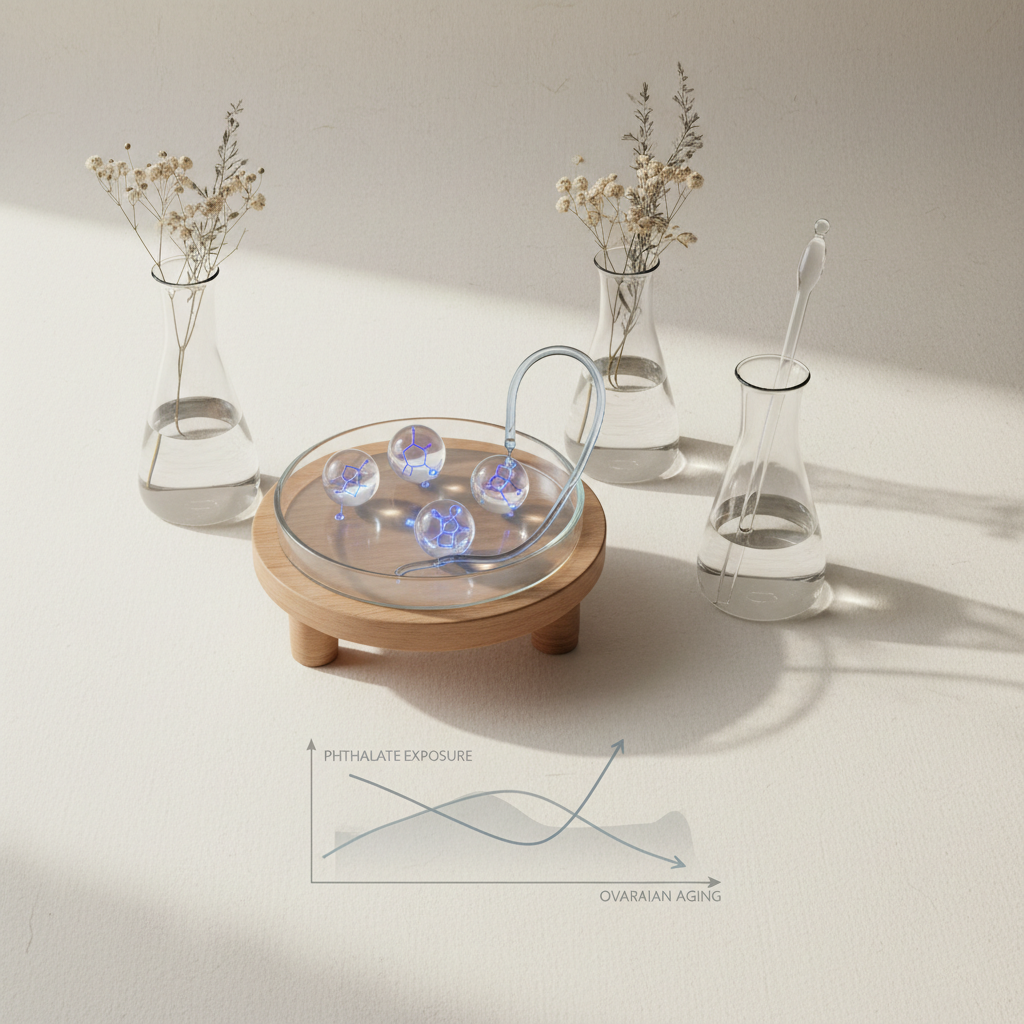
[!answer] Research is exploring whether phthalates—chemicals used in many plastics and cosmetics—accelerate ovarian aging. As endocrine disruptors, they may interfere with the hormonal systems that regulate fertility, though the direct causal link to premature ovarian decline in humans is an area of active and complex scientific investigation.
This connection, while not yet definitive, has become a critical focus in environmental health, urging a closer look at the subtle ways everyday exposures might influence long-term reproductive wellness. The conversation isn't about causing alarm, but about building awareness and understanding the science as it unfolds.
What are phthalates, and where are they found?
Phthalates (pronounced THA-lates) are a large family of synthetic chemicals used primarily to make plastics like polyvinyl chloride (PVC) more flexible and durable. They are also used as solvents or binding agents in a vast array of consumer goods. This versatility means they can be found in everything from vinyl flooring and shower curtains to food packaging, medical devices, and, notably, personal care products.
In cosmetics, phthalates have historically served several functions. Diethyl phthalate (DEP) is often used to stabilize synthetic fragrances, helping a scent last longer on the skin. Other types, like dibutyl phthalate (DBP), have been used as plasticizers in nail polish to prevent chipping. Because they are not chemically bound to the products they’re in, phthalates can leach out over time, leading to widespread and continuous human exposure through ingestion, inhalation, and skin absorption.
What is premature ovarian aging?
Premature ovarian aging, sometimes referred to as diminished ovarian reserve (DOR), is a condition where the ovaries lose their normal reproductive potential earlier than expected. Every woman is born with a finite number of eggs, a supply that naturally and gradually declines with age until menopause. Ovarian reserve refers to the quantity and quality of these remaining eggs.
In cases of premature ovarian aging, this decline happens faster or starts from a lower baseline. It means a person might have fewer eggs, or eggs of poorer quality, than is typical for their age group. This can lead to difficulties conceiving and may signal an earlier onset of menopause. It’s distinct from premature ovarian insufficiency (POI), where ovarian function ceases before age 40, but it exists on the same spectrum of declining fertility.
How might phthalates affect ovarian function?
The primary concern with phthalates is their well-documented ability to act as endocrine-disrupting chemicals (EDCs). The endocrine system is a delicate network of glands and hormones that regulates nearly every process in the body, including growth, metabolism, and reproduction. EDCs can interfere with this system by mimicking, blocking, or altering the production of natural hormones.
The female reproductive system, particularly the ovaries, is exquisitely sensitive to hormonal cues. The entire cycle of follicular development, egg maturation, and ovulation is orchestrated by a precise rhythm of hormones like estrogen, progesterone, and follicle-stimulating hormone (FSH). By potentially scrambling these signals, phthalates may disrupt the very processes that sustain a healthy ovarian reserve. Several animal studies have suggested that exposure to certain phthalates can lead to fewer mature follicles, a higher rate of egg cell death (atresia), and altered hormone levels—all markers consistent with aging ovaries.
[!quote] It is now clear... that plastics are also responsible for significant harms to human health... These harms occur at every stage of the plastic life cycle. — [1]
What does the new research actually say?
The question of whether these mechanistic concerns translate to premature ovarian aging in humans is a major focus of current research. While no single study has provided a final, conclusive answer, the weight of the evidence is growing. Broad, multi-institutional reviews like the Minderoo-Monaco Commission have established a clear consensus that the chemical components of plastics are responsible for significant harm to human health, including reproductive outcomes [1]. This provides a strong foundation for investigating specific effects like ovarian aging.
Establishing a direct link is incredibly complex. The gold standard for this type of question is a longitudinal cohort study, which tracks a large group of people over many years. Researchers would measure phthalate exposure (usually through metabolites in urine) at regular intervals and simultaneously monitor markers of ovarian reserve, such as Anti-Müllerian Hormone (AMH) levels in the blood. Several such studies are underway, but their long-term nature means definitive results take time.
While we await more direct data on ovarian aging, a significant body of existing research has already connected phthalates to other adverse reproductive outcomes. For a comprehensive overview, you can explore ElysiNexa's guide to the scientific evidence on phthalates and ovarian health. The evidence connecting these chemicals to hormonal disruption is substantial enough to warrant a precautionary approach.
Why is this connection so difficult to prove?
Studying the link between a common chemical and a slow-developing health outcome is fraught with challenges. First, phthalate exposure is ubiquitous; it is nearly impossible to find a "control" group of unexposed individuals to compare against. Scientists must instead look for correlations between levels of exposure and health outcomes, which is a more complex statistical task.
Second, we are exposed to a "cocktail" of many different chemicals, including various types of phthalates and other EDCs, all at once. Isolating the effect of a single chemical from this background noise is a significant hurdle. The cumulative effect of these mixtures may be more potent than the sum of its parts. Finally, there can be a long latency period—even decades—between a critical window of exposure (such as in utero or during childhood) and the emergence of a health issue like diminished ovarian reserve, making cause-and-effect difficult to pin down.
[!quote] The central concern is that by interfering with the body's intricate hormonal symphony, these chemicals may silently accelerate the natural decline of ovarian function. — [1]
How can you reduce your exposure to phthalates?
While avoiding phthalates entirely is not practical in the modern world, you can significantly reduce your exposure with mindful choices. Since cosmetics and personal care products are a key source of dermal exposure, this is a powerful place to start. Many brands are now actively formulating without these chemicals in response to consumer demand and increasing regulation.
When reading ingredient labels, look for "phthalate-free" or "no phthalates" claims on the packaging. Be wary of the generic term "fragrance" or "parfum," as it can be a legal hiding place for a proprietary blend of chemicals, including phthalates used as scent stabilizers. For a more detailed walkthrough, see our guide to finding and avoiding phthalates in cosmetics. Beyond beauty products, you can reduce exposure by choosing fresh, whole foods over those packaged in soft plastics, avoiding microwaving food in plastic containers, and using glass, stainless steel, or ceramic for food storage.
The takeaway
The link between phthalate exposure and premature ovarian aging is a plausible and concerning hypothesis backed by mechanistic data and observations from broader health commissions [1]. While direct human evidence is still developing, the role of phthalates as endocrine disruptors is well-established, justifying a conscious effort to reduce exposure, particularly for those concerned about their long-term reproductive health.
Sources
- [1] The Minderoo-Monaco Commission on Plastics and Human Health. — Landrigan PJ, Raps H, Cropper M, Bald C, Brunner M, Canonizado EM, Charles D, Chiles TC, Donohue MJ, Enck J, Fenichel P, Fleming LE, Ferrier-Pages C, Fordham R, Gozt A, Griffin C, Hahn ME, Haryanto B, Hixson R, Ianelli H, James BD, Kumar P, Laborde A, Law KL, Martin K, Mu J, Mulders Y, Mustapha A, Niu J, Pahl S, Park Y, Pedrotti ML, Pitt JA, Ruchirawat M, Seewoo BJ, Spring M, Stegeman JJ, Suk W, Symeonides C, Takada H, Thompson RC, Vicini A, Wang Z, Whitman E, Wirth D, Wolff M, Yousuf AK, Dunlop S.. 2023 · Europe PMC
- [2] ISEE North America Chapter (NAC) Conference 2026 Abstracts. 2025 · Europe PMC
- [3] Supplement: Biochemistry for the next 50 years, 50th FEBS Congress, 4-8 July 2026, Maastricht, The Netherlands.. 2026 · Europe PMC
- [4] Posters. 2026 · Europe PMC
- [5] Human biomarker navigator. — Li MY, Zhang Q, Wang Z, Gui Z, Liu J, Li J, Jiang M, Chang Z, Han Q, Yang B, Saeed T, Li J, Jia J, Song C, Shao T, Peng T, Zhang X, Guo P, Luo J, Yang G, Wan Y, Zengin G, Yuan Q, Li L, Fan X, Luo Y, Zhu L, Zheng Y, Mao W, Sun W.. 2026 · Europe PMC