Guides
Your Guide to Finding and Avoiding Phthalates in Cosmetics
Identify and avoid endocrine-disrupting phthalates in cosmetics by checking for "phthalate-free" labels and avoiding products with "fragrance" or "parfum".
May 31, 2026
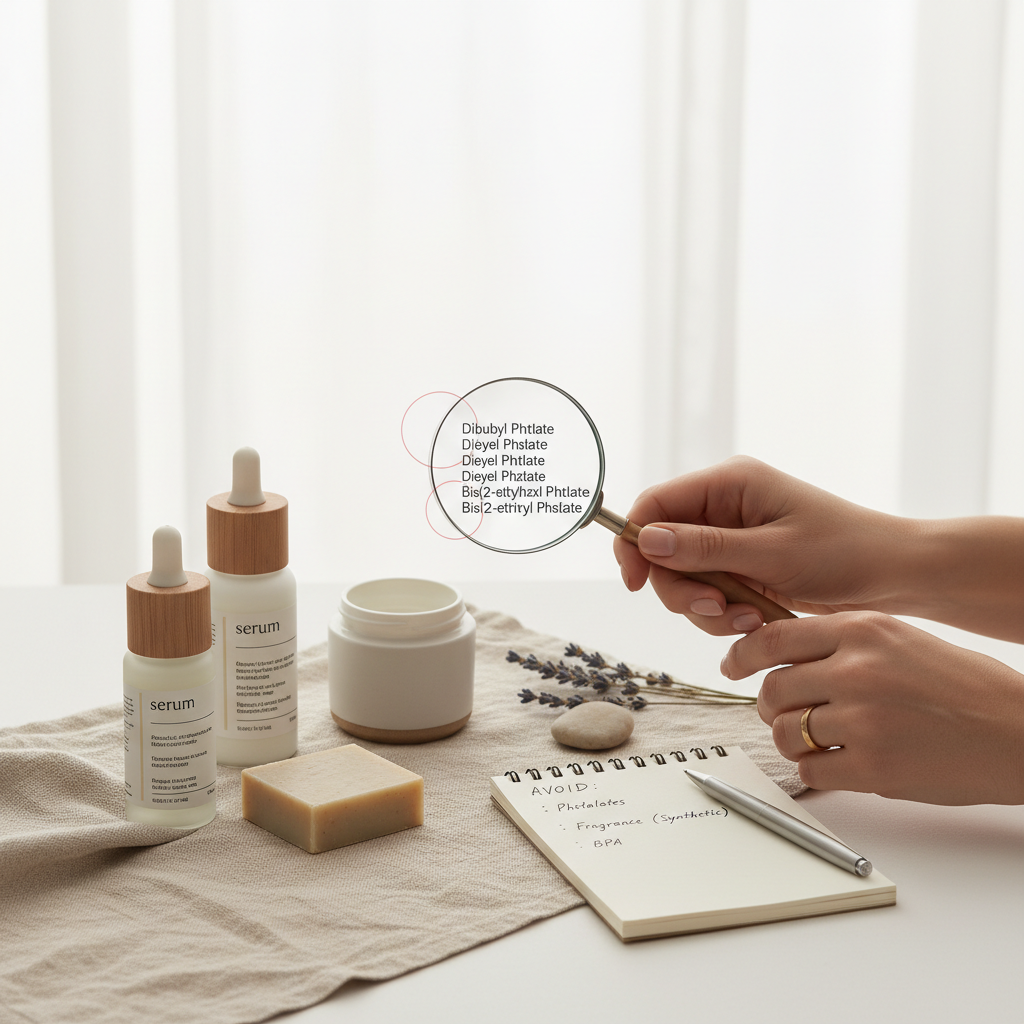
[!answer] Phthalates are endocrine-disrupting chemicals used in cosmetics to make fragrances last longer and plastics more flexible. To identify and avoid them, look for 'phthalate-free' on the label, choose 'fragrance-free' products, and read ingredient lists to steer clear of chemicals with 'phthalate' in their name, like Dibutyl Phthalate (DBP).
These invisible chemical additives are some of the most common ingredients in our daily routines. Taking a closer look at what they are, and how to navigate them, is less about alarm and more about informed, intentional self-care.
What are phthalates, and why are they in my products?
Phthalates (pronounced THA-lates) are a family of chemical plasticizers and solvents used for decades to make products more durable, flexible, and long-lasting. In the world of personal care, they perform several key functions. You might find them in nail polish to prevent chipping, in hairspray to provide a flexible hold, or in lotions and creams to improve absorption. One of their most common uses, however, is as a fixative in fragrances, helping the scent linger on the skin for hours.
Because they are so versatile, they appear in a vast range of items. While many people associate them with soft PVC plastics, they are just as prevalent on the beauty counter. The most common phthalate found in cosmetics is Diethyl Phthalate (DEP), primarily used in fragrances. Others, like Dibutyl Phthalate (DBP), have historically been used in nail polishes, although its use has declined due to consumer pressure and evolving regulations.
These chemicals are not chemically bound to the products they are in, which means they can leach out over time. This quality is central to the discussion around their health effects. When we apply a lotion, spray a perfume, or paint our nails, we are creating a pathway for these compounds to be absorbed into our bodies.
How do phthalates affect the body?
Phthalates can interfere with the body's hormonal system, which is why they are classified as endocrine-disrupting chemicals (EDCs). They primarily do this by mimicking or blocking the body's natural hormones, such as estrogen and testosterone, or by altering the way these hormones are produced, transported, and metabolized [1]. This interference can throw the body's delicate hormonal balance out of equilibrium, which is linked to a variety of health concerns.
Mounting evidence points specifically to impacts on reproductive health. Reviews of environmental contaminants have identified EDCs like phthalates as a significant factor in declining semen quality and male infertility, primarily by triggering hormonal imbalance and oxidative stress [2]. The conversation extends beyond male fertility, with research investigating links between EDC exposure and a range of issues affecting metabolism, neurodevelopment, and overall hormonal health [1]. For a more detailed look at the evidence, our article on phthalates and reproductive health offers a deeper scientific review.
Because the endocrine system governs so many bodily functions—from our metabolism and mood to our sleep cycles and reproductive capabilities—disruptions can have far-reaching effects. The concern is not typically about a single, acute exposure, but rather the low-level, chronic exposure from numerous sources over a lifetime. This cumulative effect is what most researchers and health advocates are focused on understanding and minimizing.
What does the research actually say about exposure from cosmetics?
Scientific studies confirm that personal care products are a significant and consistent source of phthalate exposure for the general population. A foundational 2012 study in Environmental Health Perspectives analyzed a range of consumer goods and detected phthalates in many of them, reinforcing the understanding that our daily routines contribute to our chemical body burden [3].
Furthermore, this exposure is not evenly distributed. Research highlights that women and girls often have higher exposure levels, largely because they use more personal care products on a daily basis [4][5]. From lotions and makeup to hair products and perfumes, the higher number of products used creates a greater cumulative exposure. This unequal burden is an important dimension of the issue, framing it not just as a chemical safety question but one of health equity.
[!quote] Despite being framed as tools for empowerment and wellness, PCPs may contribute to disproportionate toxic exposures, particularly for women and girls. — [4]
It’s important to maintain perspective: cosmetics are not the only source of phthalate exposure. These chemicals are also found in food packaging, vinyl flooring, and medical supplies. However, personal care products represent a direct and modifiable route of exposure that we have a significant degree of control over as consumers. Changing our purchasing habits can directly lower our personal exposure.
Are some people more vulnerable to phthalate exposure?
Yes, infants, children, and the developing fetus are particularly vulnerable to the effects of endocrine disruptors like phthalates. The health risks are most pronounced during critical windows of development, when the body's hormonal signals are orchestrating complex processes of organ formation and maturation [6].
During these early life stages, detoxification systems are not yet fully developed, and the blood-brain barrier is more permeable. This means that children and fetuses are less able to break down and excrete these chemicals, making them more susceptible to their effects at lower doses. Exposure during pregnancy is a key area of concern, as phthalates can cross the placenta. Emerging research continues to explore the connections between prenatal phthalate exposure and neurodevelopmental outcomes in children.
This heightened vulnerability is why regulatory bodies and pediatric health advocates often recommend taking a more precautionary approach for products intended for children or those who are pregnant. The potential for long-term health consequences from early-life exposure underscores the importance of minimizing contact with EDCs wherever possible.
How can I identify phthalates on an ingredient label?
Finding phthalates on a label can be tricky, as they can be listed explicitly or hidden from view. The most direct way to identify them is to scan the ingredient list for chemical names that include the word "phthalate." The most common ones to watch for are Dibutyl Phthalate (DBP), Diethyl Phthalate (DEP), and Dimethyl Phthalate (DMP). Seeing any of these on a label is a clear sign the product contains them.
However, phthalates are often not listed at all. Due to a regulatory loophole that protects fragrance formulations as "trade secrets," companies are permitted to use the single word "fragrance" or "parfum" on an ingredient list to represent a complex mixture of dozens, or even hundreds, of chemicals. Phthalates, particularly DEP, are frequently used in these proprietary blends to make the scent last longer. This means a product can be full of phthalates without you ever knowing it from the label.
This "fragrance loophole" is the single biggest challenge for consumers trying to avoid these chemicals. Unless a product is explicitly marketed as "fragrance-free" or "phthalate-free," there is a strong possibility that any product with "fragrance" on the ingredient list contains them. For a broader overview of this and other similar ingredients, see our guide to spotting endocrine disruptors on a cosmetics label.
What are the most effective ways to avoid them?
The most effective strategies for avoiding phthalates involve reading labels, understanding what they do and don't say, and making intentional choices about the products you purchase. The simplest approach is to prioritize products that are explicitly labeled as both "fragrance-free" and "phthalate-free." Many brands that avoid these ingredients will use it as a marketing callout on their packaging.
Be mindful of the distinction between "fragrance-free" and "unscented." "Fragrance-free" means no fragrances have been added. "Unscented" products, on the other hand, may contain masking fragrances used to cover up the chemical smell of the other ingredients. The safer bet is always "fragrance-free."
[!quote] Despite known health risks, existing policies often fail to provide adequate protection, with gaps remaining in understanding women's knowledge, risk perceptions, and beliefs about EDCs... and how these influence avoidance behaviours. — [5]
Beyond looking for specific claims, simplifying your routine can also make a difference. Using fewer products overall can help reduce your cumulative chemical exposure from all sources. Instead of layering multiple scented products (e.g., lotion, body spray, and hair product), consider choosing only one scented item or opting for unscented versions of the others. By becoming a more discerning and informed shopper, you can significantly reduce your daily contact with these chemicals.
The takeaway
Navigating phthalates in personal care is about awareness, not anxiety. The most powerful tools at your disposal are reading ingredient lists, prioritizing products labeled "phthalate-free" or "fragrance-free," and supporting brands that practice transparency. By making deliberate choices, you can curate a self-care routine that is both effective and aligned with your long-term well-being.
Sources
- [1] Endocrine disruptors and asthma-associated chemicals in consumer products. — Dodson RE, Nishioka M, Standley LJ. Environmental health perspectives (2012) · PubMed
- [2] Knowledge, attitudes, and practices regarding personal care products and their perceived link to breast cancer: a cross-sectional study. — Tariq MB, Jaffar N, Farhan K, Tanveer M, Salomon I, Anum F, Ahmed A, Aaqil I.. 2025 · Europe PMC
- [3] Environmental determinants of male infertility: emerging threats and technological interventions. — Jagadesh P, Sridharan TB.. 2026 · Europe PMC
- [4] Gender, self-care and toxic exposures: a narrative review of personal care product use and health equity implications. — Prifti E, El-Osta A.. 2025 · Europe PMC
- [5] Analysis of Women's Knowledge, Health Risk Perceptions, Beliefs and Avoidance Behaviour in Relation to Endocrine-Disrupting Chemicals in Personal Care and Household Products. — Trifunovski A, Rotondi NK, Abbass-Dick J, Barakat C.. 2025 · Europe PMC
- [6] Endocrine disruptors and children's health. — Karakiliç E, Doğan D, Saygili ES.. 2025 · Europe PMC