Studies
Titanium Dioxide in Powders: A Look at Inhalation Safety
Inhaling titanium dioxide from loose cosmetic powders poses theoretical lung risks, primarily from high-dose occupational exposure, but cumulative effects of.
July 28, 2026
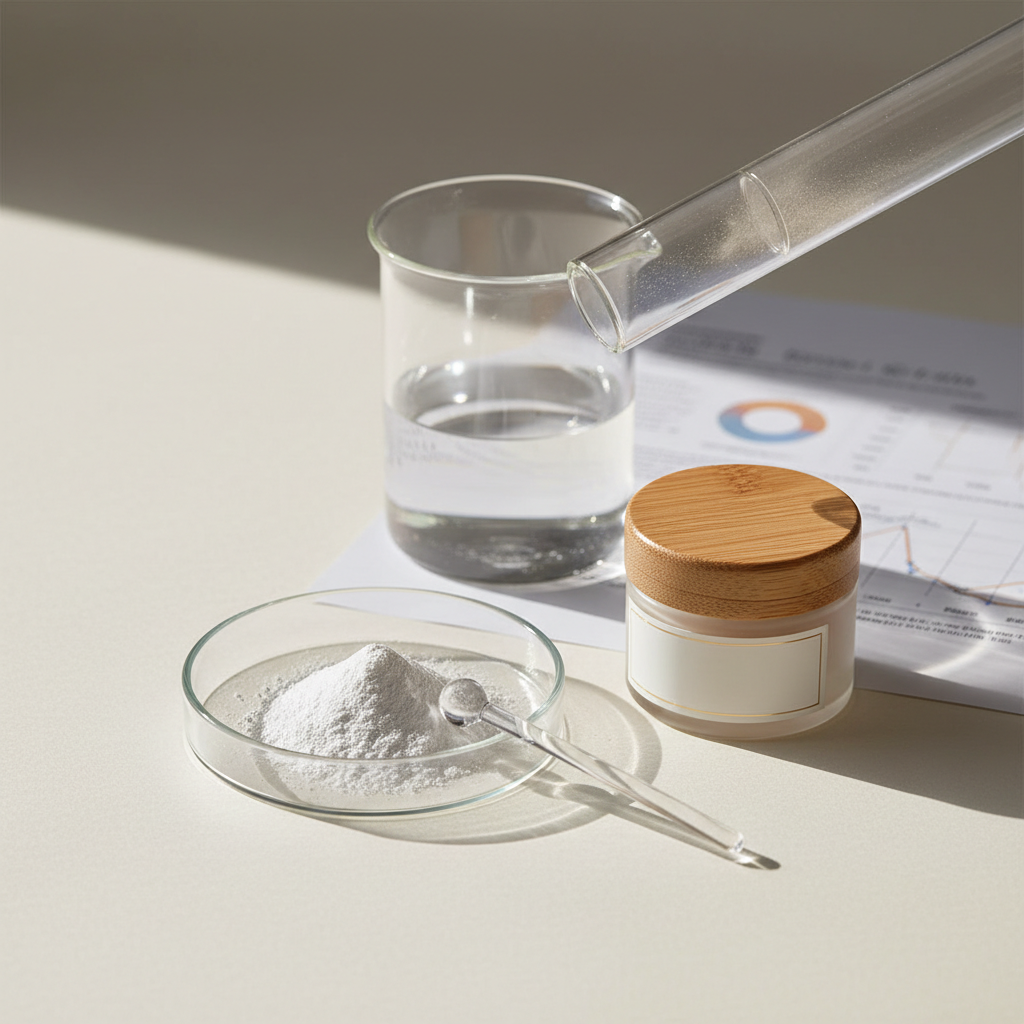
[!answer] Inhaling nano-sized titanium dioxide particles represents a potential lung risk, primarily demonstrated in high-dose occupational studies. For daily cosmetic use of loose powders, exposure is much lower, and while regulators consider it safe, the long-term effects of chronic, low-level inhalation are still under scientific review.
Mineral makeup, with its seemingly simple ingredient lists, has long been a favorite in the clean beauty world. But as our scientific understanding of materials evolves, so does our scrutiny of even the most common ingredients, including the ubiquitous white pigment, titanium dioxide.
What exactly is titanium dioxide?
Titanium dioxide (TiO2) is a naturally occurring mineral that is processed and purified for use in a vast array of consumer products. In cosmetics, it serves two primary functions. First, it is an exceptional white pigment, used to provide opacity and adjust the tone of foundations, concealers, and powders. Second, in its nanoparticle form, it functions as a highly effective physical sunscreen, scattering and absorbing both UVA and UVB radiation to protect the skin from sun damage.
Its safety record for topical use is extensive and robust; it is considered non-irritating and non-allergenic for most skin types. The concerns that have emerged in recent years are not about what happens when it sits on top of the skin, but what might happen if it gets inside the body through unintended routes. A growing body of research is exploring the a wide range of synthetic chemicals in personal care products, with some studies suggesting links between long-term use and chronic health issues [1].
Where does the inhalation concern come from?
The concern comes from a critical distinction: the difference between a solid cream on your skin and a fine, airborne powder that can be accidentally inhaled. While the skin provides a formidable barrier, the lungs are designed for absorption. The conversation around TiO2 inhalation risk began in the world of occupational health, with studies on factory workers exposed to high concentrations of TiO2 dust over many years.
In 2006, the International Agency for Research on Cancer (IARC) classified titanium dioxide as a "Group 2B" carcinogen, meaning it is "possibly carcinogenic to humans." This classification sounds alarming, but the context is crucial. It was based exclusively on studies of rats exposed to very high levels of pigment-grade TiO2 dust that caused persistent lung inflammation and, eventually, tumors. The IARC noted that no adequate human studies confirmed this risk, and the classification applies specifically to chronic, high-dose inhalation—conditions not typically faced by the average cosmetic user.
How do fine particles behave in the lungs?
To understand the risk, it helps to understand the environment of the lungs. The lungs are not empty bags; they are an intricate, branching system of airways ending in tiny sacs called alveoli, where gas exchange occurs. This entire system is lined with a delicate layer of cells, known as the epithelium. It is designed to be incredibly thin and permeable to allow oxygen to pass into the blood, but this also makes it vulnerable.
When you inhale a fine powder, the particles travel down these airways. Larger particles might get trapped in the upper airways and cleared out by mucus, but smaller particles can travel deeper. Research into pulmonary drug delivery shows that nanoparticles, specifically, can reach the deepest parts of the lungs, where the body’s clearance mechanisms are less effective [2]. Because they aren't easily broken down or removed, these tiny foreign particles can remain in the lung tissue for long periods, potentially triggering a persistent, low-grade inflammatory response.
[!quote] Since the 1960s, more than 350,000 new chemicals have been introduced into the lives of humans and domestic animals. Many of them have become part of modern life and some are affecting nature as pollutants. Yet, our comprehension of their potential health risks...remains partial. — [3]
What does the science say about how nanoparticles could cause harm?
The primary mechanism of concern is chronic inflammation. According to the "epithelial barrier theory," the protective cell layers lining our lungs, gut, and skin are critical gatekeepers for our health [3]. When this barrier is repeatedly damaged or stressed by foreign substances—like inhaled particles—it can become dysfunctional.
This low-grade, long-term inflammation can disrupt the normal functioning of the lung tissue. The constant immune response can lead to oxidative stress and cellular damage, which, over a timescale of decades, is a known risk factor for a variety of diseases. The concern is not an acute reaction, but a slow, cumulative process. While the debate over specific cosmetic ingredients continues, the underlying science emphasizes the importance of maintaining a healthy epithelial barrier as a first line of defense against environmental exposures [3].
Is the titanium dioxide in loose powder a nanoparticle?
This is a key question, and the answer is complex. Titanium dioxide comes in two main forms for cosmetics: "pigment-grade" and "nanoparticle-grade." Nanoparticle TiO2, which is defined by particles smaller than 100 nanometers, is favored for sunscreens because its small size makes it transparent on the skin while still providing broad-spectrum UV protection. Pigment-grade TiO2 has larger particles, which are better at scattering light and providing the white, opaque coverage desired in a foundation or setting powder.
However, "pigment-grade" is not a perfectly uniform category. Any powder is made up of a distribution of particle sizes. While the average particle size might be well above the nano-threshold, the manufacturing process can still result in a fraction of particles that fall into the nanoparticle range. Therefore, it is plausible that most loose powders containing titanium dioxide will have at least some proportion of inhalable, nano-sized particles, even if they aren't explicitly formulated with "nano-TiO2."
So, how should I interpret this risk for my daily makeup routine?
This is where context and dose are everything. The amount of powder you might inhale while applying your makeup is minuscule compared to the exposures in the occupational studies that first raised alarms. Even so, the concern for cosmetic users is about chronic, low-level exposure over a lifetime. Similar concerns about long-term inhalation risks have been raised about other aerosolized products, from the VOCs in hair salons to contaminants in dry shampoos. For a deeper look at this, our article on air quality in hair salons explores related occupational concerns.
Currently, major regulatory bodies like the FDA and the EU's Scientific Committee on Consumer Safety (SCCS) have reviewed the evidence and continue to consider titanium dioxide safe for use in cosmetics, including loose powders, at current concentrations. Their assessments acknowledge the inhalation concern but have generally concluded that the exposure level from normal cosmetic use is too low to present a significant risk. Yet, science is always evolving, and the issue of contaminants in powder products remains an active area of discussion, as seen in the recent concerns over benzene in dry shampoos.
[!quote] The "epithelial barrier theory" suggests that genetic predisposition and exposure to diverse factors damaging the epithelial barriers contribute to the emergence of allergic and autoimmune conditions. — [3]
How can I choose a safer powder?
For anyone who prefers to be cautious while the science evolves, there are simple, effective ways to minimize any potential risk. The concern is entirely linked to the potential for the product to become airborne. Therefore, the easiest solution is to choose product formats that don't create dust.
Cream foundations, liquid concealers, and pressed-powder compacts (which are bound with oils or waxes) do not pose the same inhalation risk as loose powders. When you do use a loose powder, apply it with a damp sponge or puff rather than a fluffy brush, and tap off the excess away from your face to minimize the amount of airborne dust. Being mindful of application is a practical and proportionate response to a risk that is, for now, largely theoretical for cosmetic users.
The takeaway
The scientific conversation around titanium dioxide confirms that inhaling fine and nano-sized particles of any poorly soluble substance is not ideal for lung health. While the risk for cosmetic users is considered low by regulators, choosing non-powdery alternatives like creams or pressed compacts is a simple, science-backed way to err on the side of caution.
Sources
- [1] The dark side of beauty: an in-depth analysis of the health hazards and toxicological impact of synthetic cosmetics and personal care products. — Alnuqaydan AM.. 2024 · Europe PMC
- [2] Liposomes or Extracellular Vesicles: A Comprehensive Comparison of Both Lipid Bilayer Vesicles for Pulmonary Drug Delivery. — Al-Jipouri A, Almurisi SH, Al-Japairai K, Bakar LM, Doolaanea AA.. 2023 · Europe PMC
- [3] Epithelial barrier dysfunction and associated diseases in companion animals: Differences and similarities between humans and animals and research needs. — Ardicli S, Ardicli O, Yazici D, Pat Y, Babayev H, Xiong P, Zeyneloglu C, Garcia-Sanchez A, Shi LL, Viscardi OG, Skolnick S, Ogulur I, Dhir R, Jutel M, Agache I, Janda J, Pali-Schöll I, Nadeau KC, Akdis M, Akdis CA.. 2024 · Europe PMC