Guides
A Guide to Finding Hidden Allergens on Cosmetic Labels
To identify hidden allergens in skin care, scrutinize generic terms like "fragrance", which can mask sensitizers, and learn to spot common allergen families.
May 31, 2026
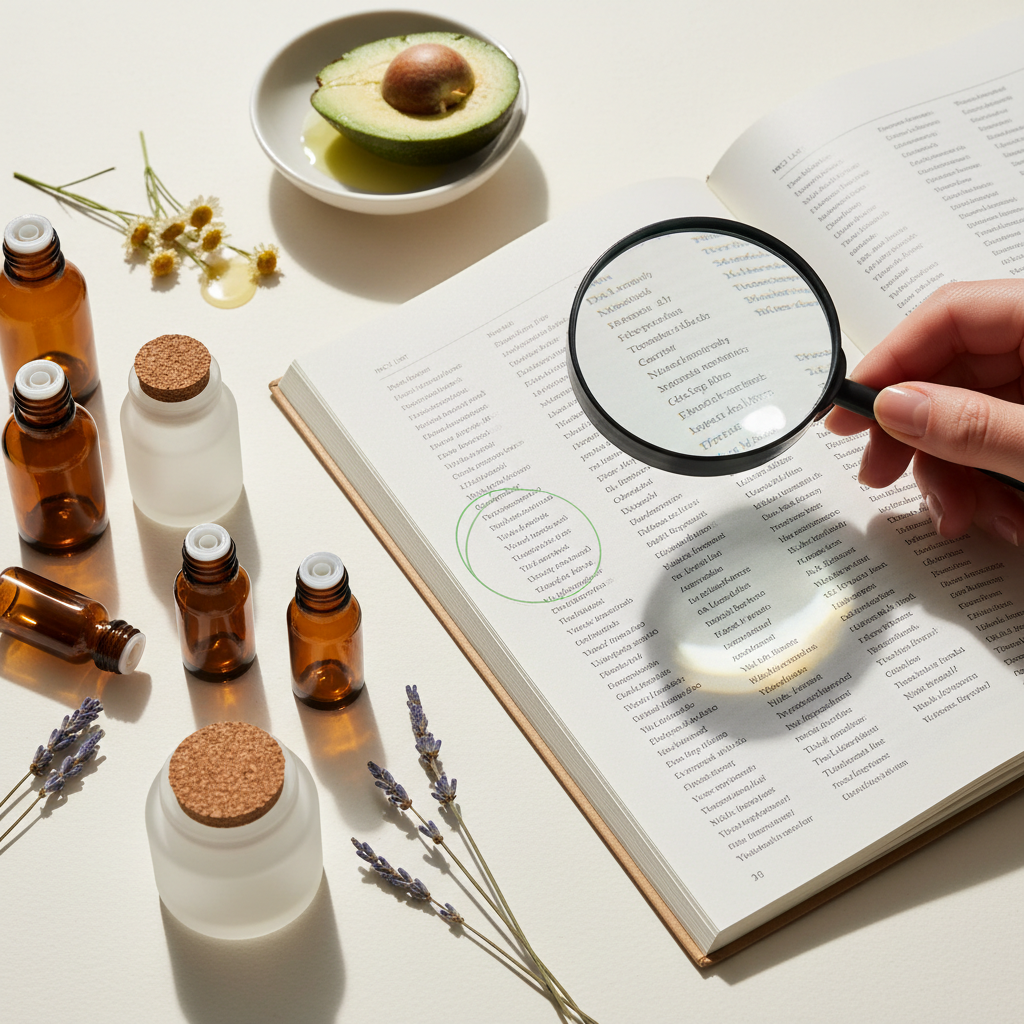
[!answer] To identify hidden allergens in personal care products, look beyond single ingredients. Scrutinize generic terms like 'fragrance' or 'parfum,' which can mask dozens of sensitizers, and learn the names of common allergen families, such as isothiazolinone preservatives or ingredients related to p-phenylenediamine (PPD) in hair dyes.
While a true allergy to a cosmetic ingredient is distinct from simple irritation, the effect—red, itchy, or painful skin—is just as real. Learning to navigate the complex world of the International Nomenclature of Cosmetic Ingredients (INCI) list is the key to protecting your skin and making informed choices.
What is a cosmetic allergen?
A cosmetic allergen is an ingredient that can trigger an allergic reaction when it comes into contact with your skin. The most common manifestation is Allergic Contact Dermatitis (ACD), a delayed hypersensitivity reaction that can cause redness, swelling, itching, and blisters, typically appearing 24 to 72 hours after exposure. This is an immune-system response, where your body has become "sensitized" to a substance, recognizing it as a foreign invader and launching an inflammatory attack against it [1].
This is different from Irritant Contact Dermatitis (ICD), which is a direct, non-immune inflammatory reaction to a harsh substance. While the symptoms can look similar, ICD can happen to anyone with enough exposure to an irritant, whereas ACD only occurs in individuals who have a specific sensitization to an allergen. For the person suffering, however, the distinction can feel academic; the end goal is the same—to identify and avoid the trigger ingredient.
Understanding sensitization is key. You may use a product for years without issue before one day developing a reaction. This happens because your immune system has reached its tolerance threshold after repeated exposures, becoming sensitized and programmed to react upon the next contact. Because of this, an allergy can seemingly appear out of nowhere, creating a frustrating mystery for the consumer.
Why are some allergens ‘hidden’ in plain sight?
Identifying a trigger ingredient isn't always as simple as reading the label. Allergens can be "hidden" in several ways, not through deliberate deception, but due to labeling conventions and chemical complexities. One of the most common ways is through umbrella terms. In the United States, "Fragrance" or "Parfum" is a legally protected trade secret, a single word that can represent a complex mixture of dozens, or even hundreds, of individual chemicals. While many of these are harmless, this mixture is also where many common sensitizers are found.
Another challenge is chemical families. You might learn you're allergic to a specific preservative like Methylisothiazolinone, but you may not realize it belongs to the isothiazolinone family. Its chemical relatives, like Methylchloroisothiazolinone or Benzisothiazolinone, could also trigger a reaction due to their similar molecular structure. To be safe, you need to learn to recognize the entire family, not just the single ingredient diagnosed in a patch test.
Finally, the rise of "clean" and "natural" beauty has created a false sense of security. Many botanical extracts and essential oils are potent allergens. Ingredients like tea tree oil, lavender, and citrus extracts contain compounds such as linalool and limonene, which are well-documented sensitizers [1]. "Natural" does not mean hypoallergenic; a poison ivy rash, after all, is a natural allergic reaction.
What are the most common hidden allergens to look for?
Dermatological research has identified several key culprits that are consistently responsible for a high number of allergic contact dermatitis cases. While individual sensitivities vary, being aware of these common triggers is the first step in protecting your skin.
- Fragrance Ingredients: This is the leading category of cosmetic allergens. While the generic "Fragrance" term is a primary concern, European regulations require 26 common fragrance allergens (a list that continues to expand) to be listed individually if they exceed a certain concentration. These include ingredients like Linalool, Limonene, Geraniol, and Cinnamal. Familiarizing yourself with this list is a proactive measure.
- Preservatives: Behind fragrance, preservatives are a major source of ACD. The isothiazolinone family is a primary concern; a preservative and known skin allergen, methylisothiazolinone (MI) became so notorious for causing reactions that it was dubbed the "Allergen of the Year" in 2013 and has since been restricted in leave-on products in the EU and Canada [1]. Formaldehyde-releasing preservatives, like DMDM hydantoin and quaternium-15, are another class to watch.
- Hair Dyes: Paraphenylenediamine (PPD) is a potent allergen found in most permanent hair dyes [1]. Individuals sensitized to PPD may also react to related chemicals, so it's vital to find hidden allergens in hair dye by looking for names like toluene-2,5-diamine.
- Metals: Nickel is one of the most common contact allergens in the world. While often associated with jewelry, it can be present as a contaminant in cosmetic pigments used in eyeshadows and other makeup. People with a known nickel allergy should be cautious with deeply colored cosmetics.
[!quote] New allergens, or previously described allergens found in a new exposure context, represent an ongoing challenge for consumers and dermatologists alike. — [1]
How can I read a label to spot them?
Becoming a proficient label reader is a skill. It requires patience and a bit of detective work, but a systematic approach can make it manageable. The goal is to decode cosmetic labels to identify common allergens before they have a chance to affect your skin.
First, be critical of the term "Fragrance" or "Parfum." If you have sensitive or reactive skin, the safest path is to choose products explicitly labeled "fragrance-free." Note that this is different from "unscented," which may mean a masking fragrance has been added to neutralize the chemical smell of the base formula.
Second, learn the naming conventions of allergen families. This is especially important for preservatives. If you know you react to one isothiazolinone, learn the other common names in that class (e.g., look for the "-isothiazolinone" suffix). Similarly, for formaldehyde-releasers, look for terms like DMDM Hydantoin, Imidazolidinyl Urea, and Quaternium-15. The same principle applies to PPD in hair dyes and its chemical cousins.
Third, do not be swayed by unregulated marketing terms like "hypoallergenic," "dermatologist-tested," or "natural." These claims are not standardized and offer no guarantee that a product is free of potential allergens. A product can be tested by a dermatologist and still cause a reaction in someone with a specific sensitivity. Always rely on the INCI list, not the front-of-box claims.
What’s the difference between an allergy and a simple skin reaction?
From a medical perspective, the difference is significant. An allergy is a specific, T-cell-mediated immune response, while a simple reaction, or irritation, is a non-specific inflammatory response from chemical damage to the skin. Consumers frequently report a wide range of adverse events, from rashes and irritation to swelling, without knowing the underlying cause [3].
For a consumer, however, the practical advice is similar: stop using the product. The key difference lies in the diagnosis. Irritation might be solved by using less of the product or using it less frequently. An allergy requires complete avoidance, as even tiny amounts of the allergen can trigger a full-blown reaction. This is why getting a proper diagnosis via patch testing is so crucial—it tells you whether you need to be cautious or completely abstain.
This distinction also explains why research into allergens is so active. At major scientific meetings, like the European Academy of Allergy and Clinical Immunology Congress, researchers constantly present new data on both the prevalence of known allergens and the identification of new ones, helping to refine diagnostic tests and public health recommendations [2].
[!quote] Fragrance is one of the most frequent causes of contact allergic reactions, with a significant part of the general population being sensitized to fragrance ingredients. — [2]
How do I confirm a suspected allergy?
If you consistently react to one or more personal care products, self-diagnosing by trial and error is often frustrating and unreliable. You may incorrectly blame an ingredient while the real culprit remains in your routine, or you may unnecessarily eliminate products that are perfectly safe for you. The gold standard for identifying a contact allergen is a dermatological procedure called patch testing.
During a patch test, small amounts of common and suspected allergens are applied to your back on adhesive panels. These patches are left on for 48 hours and then removed. Your dermatologist will then examine your skin for reactions at the 48-hour mark and again at 72 or 96 hours. A red, raised, or blistered spot corresponding to a specific substance confirms an allergy to it.
Patch testing provides definitive, actionable answers. It can uncover unexpected allergies and give you a clear list of ingredients to avoid. Bringing your own products that you suspect are causing issues can also be helpful, as the dermatologist may be able to test their individual components. Armed with this information, you can finally shop with confidence.
The takeaway
Navigating the world of cosmetic ingredients when you have reactive skin can feel daunting, but it is entirely manageable with the right approach. Focus on reading INCI lists critically, choosing fragrance-free products when in doubt, understanding that "natural" is not a synonym for "safe," and learning to spot the major chemical families of allergens. Most importantly, if you suspect an allergy, seek a professional diagnosis from a dermatologist to get clear, reliable answers.
Sources
- [1] Contact Allergy-Emerging Allergens and Public Health Impact. — Uter W, Werfel T, Lepoittevin JP, White IR.. 2020 · Europe PMC
- [2] Abstracts from the European Academy of Allergy and Clinical Immunology Congress, 26-30 May 2018, Munich, Germany.. 2018 · Europe PMC
- [3] OpenFDA Cosmetic Adverse Event Report (#1). FDA Adverse Event Reporting System (2022) · OpenFDA