Guides
A Shopper's Guide to Spotting Endocrine Disruptors on Labels
Learn to identify common endocrine disruptors on cosmetic labels. Look for phthalates (often hidden in 'fragrance'), certain parabens, and UV filters.
June 25, 2026
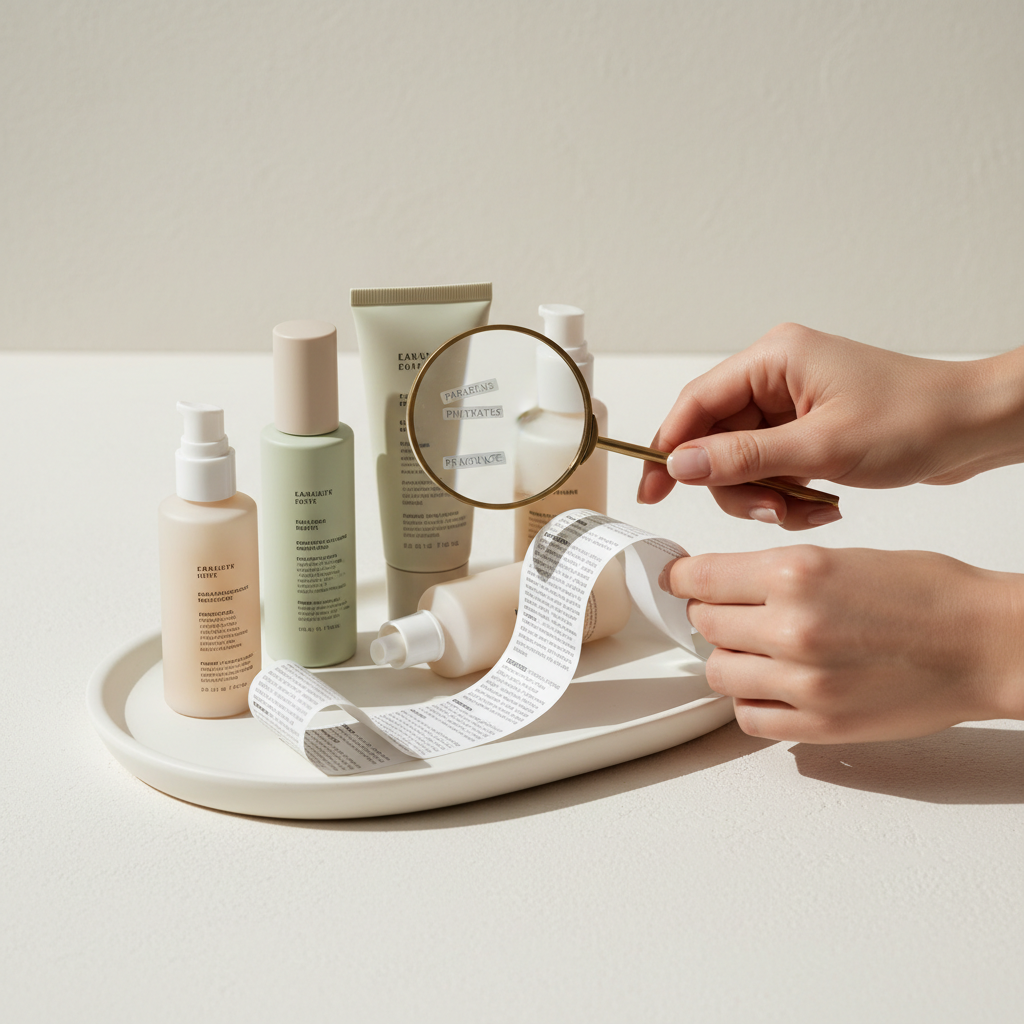
[!answer] To identify common endocrine disruptors on cosmetic labels, focus on specific ingredient names. Look for phthalates (often hidden under “fragrance” or “parfum”), long-chain parabens (like propylparaben), certain chemical UV filters (such as oxybenzone and homosalate), and ingredients like resorcinol, especially in hair dyes.
While the science on low-dose exposure continues to evolve, learning to decipher an ingredient list is an empowering way to make choices that align with your personal comfort level. It’s not about fear, but about informed awareness of what goes onto, and into, your skin.
What exactly are endocrine disruptors?
Endocrine-disrupting chemicals (EDCs) are substances that can interfere with the body’s endocrine (or hormone) system. They can mimic, block, or otherwise disrupt the normal function of hormones like estrogen and thyroid hormones, which are critical for development, reproduction, metabolism, and mood. This interference is a concern because the endocrine system operates on incredibly precise, minute fluctuations, and even small disruptions could have potential health effects over time [1].
In cosmetics, these ingredients aren’t added with malicious intent; they serve specific functions that make products effective and stable. For example, some are powerful preservatives that prevent the growth of harmful bacteria and mold. Others are used to help a formula penetrate the skin, protect from UV radiation, or make a fragrance last longer. The conversation around EDCs is nuanced—it involves understanding not just the ingredients themselves, but the concentration, the product type, and your total daily exposure.
How can I spot phthalates on an ingredient list?
This is one of the trickiest categories for a label-reader, as you often won’t see the word “phthalate” on an ingredient list. Phthalates are most commonly hidden under the catch-all terms “fragrance,” “parfum,” “aroma,” or “flavor.” They are used as solvents and fixatives to help scents linger on the skin. While not all fragrances contain them, the formulation is considered a trade secret in many regions, so manufacturers are not required to disclose the specific chemical components.
One of the most comprehensive studies analyzing consumer goods found diethyl phthalate (DEP) in a wide range of products, including perfumes, deodorants, and lotions [2]. While the health effects of low-dose DEP from cosmetics are still debated, the primary concern revolves around cumulative exposure from multiple sources. For those looking to minimize exposure, your guide to finding and avoiding phthalates in cosmetics can be a helpful resource. The most direct strategy is to choose products explicitly labeled “phthalate-free” or opt for fragrance-free items and those scented only with essential oils.
Which parabens should I look out for?
Parabens are highly effective preservatives used to give products a long shelf life, and you can spot them by looking for ingredients ending in “-paraben.” The most common are methylparaben, ethylparaben, propylparaben, and butylparaben. The science on parabens is complex and often contested. Regulators like the EU’s Scientific Committee on Consumer Safety (SCCS) and the FDA have repeatedly reviewed them and found that the short-chain parabens (methyl- and ethyl-) are safe at the low concentrations used in cosmetics, as they are quickly metabolized and excreted.
However, concern remains focused on long-chain parabens, specifically propylparaben and butylparaben. These have shown weak estrogen-mimicking activity in lab studies, and while the effect is thousands of times weaker than the body’s own estrogen, the question of long-term, cumulative exposure is still under active research [3]. As a result, some consumers and clean beauty retailers choose to avoid them. Many brands now use alternative preservatives, so finding “paraben-free” products is easier than ever.
[!quote] Despite the availability of safer alternatives, many lack the knowledge to identify harmful substances in personal care products and to seek out alternatives. — [3]
Are chemical sunscreens a concern?
Certain organic UV filters, often called “chemical sunscreens,” are effective at absorbing UV radiation but have come under scrutiny for their potential as endocrine disruptors. Ingredients like oxybenzone (benzophenone-3), octinoxate (ethylhexyl methoxycinnamate), and homosalate are key examples. Studies have confirmed that these chemicals are absorbed into the bloodstream after topical application, and some have been detected in human samples [4].
Research has specifically investigated their impact on thyroid function, with both in vitro (lab) and in vivo (living organism) studies showing that some filters can interfere with thyroid hormone pathways [4]. In response to this and other data, regulatory bodies like the FDA are re-evaluating the safety of several of these ingredients, noting that their systemic absorption and weak hormonal effects are under review. For individuals who prefer to err on the side of caution, mineral sunscreens containing zinc oxide or titanium dioxide are considered non-penetrating alternatives that physically block UV rays without being absorbed into the skin.
What about EDCs in hair products?
Hair products, particularly permanent hair dyes, can contain their own unique set of potential endocrine disruptors. One of the most-studied is resorcinol, an ingredient used to help the color develop and bind to the hair shaft. It’s effective, but it’s also a known skin irritant and has been linked to thyroid disruption in animal and human studies.
Occupational exposure is a significant concern. For example, a French study on hairdressers highlighted that these professionals are continuously exposed to a cocktail of chemicals, including resorcinol, parabens, and phthalates, with potential impacts on thyroid health [5]. While a client’s exposure from a salon visit every 6-8 weeks is much lower, stylists face a much higher cumulative dose, and their health outcomes have informed much of the science in this area. In fact, studies confirm that stylists are exposed to higher levels of airborne chemicals with known links to respiratory and skin issues. When checking a hair dye box, you will find “resorcinol” clearly listed on the ingredient panel if it is present.
Is the "cocktail effect" a real problem?
The central challenge in assessing the risk of EDCs in cosmetics isn't the safety of a single ingredient in a single product, but the "cocktail effect" of combined, cumulative exposures from dozens of sources over a lifetime. While the dose of any one chemical in your daily moisturizer might be negligible, we are also exposed through food, water, air, and other consumer goods. This concept is often called the "body burden" [2].
Scientific studies that test products off the shelf consistently find a mixture of potential EDCs, such as parabens, phthalates, and UV filters, all within the same bottle [2]. This reflects the real-world scenario where our bodies have to process a complex mixture, not just isolated chemicals. Researchers are still working to understand how these low-dose mixtures interact and what the long-term health implications might be. This uncertainty is what motivates many people to reduce their exposure where they can, and personal care products are often the easiest place to start.
The takeaway
Reading an ingredient label shouldn’t be a source of stress but a tool for empowerment. Rather than trying to avoid everything at once, start by identifying one or two ingredient categories that concern you most and focus on finding alternatives for your most frequently used, leave-on products like lotions and sunscreens. This single habit can significantly reduce your daily cumulative exposure and give you more control over your personal care routine.
Sources
- [1] The dark side of beauty: an in-depth analysis of the health hazards and toxicological impact of synthetic cosmetics and personal care products. — Alnuqaydan AM.. 2024 · Europe PMC
- [2] Endocrine disruptors and asthma-associated chemicals in consumer products. — Dodson RE, Nishioka M, Standley LJ. Environmental health perspectives (2012) · PubMed
- [3] Risk perception of personal care products: A scoping review of knowledge translation strategies in environmental health. — Diyab R, De Michino G, Yousufzai SJ, Barakat C.. 2025 · Europe PMC
- [4] Thyroid disrupting effects of exposure to sunscreens: in vitro and in vivo evidence of the impact of organic UV-filters. — Greco A, Franchi E, Denegri M, Ambrosino S, Magri F, Coperchini F, Rotondi M.. 2025 · Europe PMC
- [5] Occupational Exposure to Resorcinol and Thyroid-Disrupting Effects: Protocol for an Exploratory Field Study in French Hairdressers. — Radauceanu A, Cambrai-Erb A, Adet B, Nioule MI, Denis F, Pons R.. 2026 · Europe PMC