Ingredients
Benzophenone-3 and Endocrine Disruption: A Scientific Review
Benzophenone-3 (oxybenzone) is a UV filter that is absorbed systemically and has known endocrine-disrupting properties under scientific review.
July 2, 2026
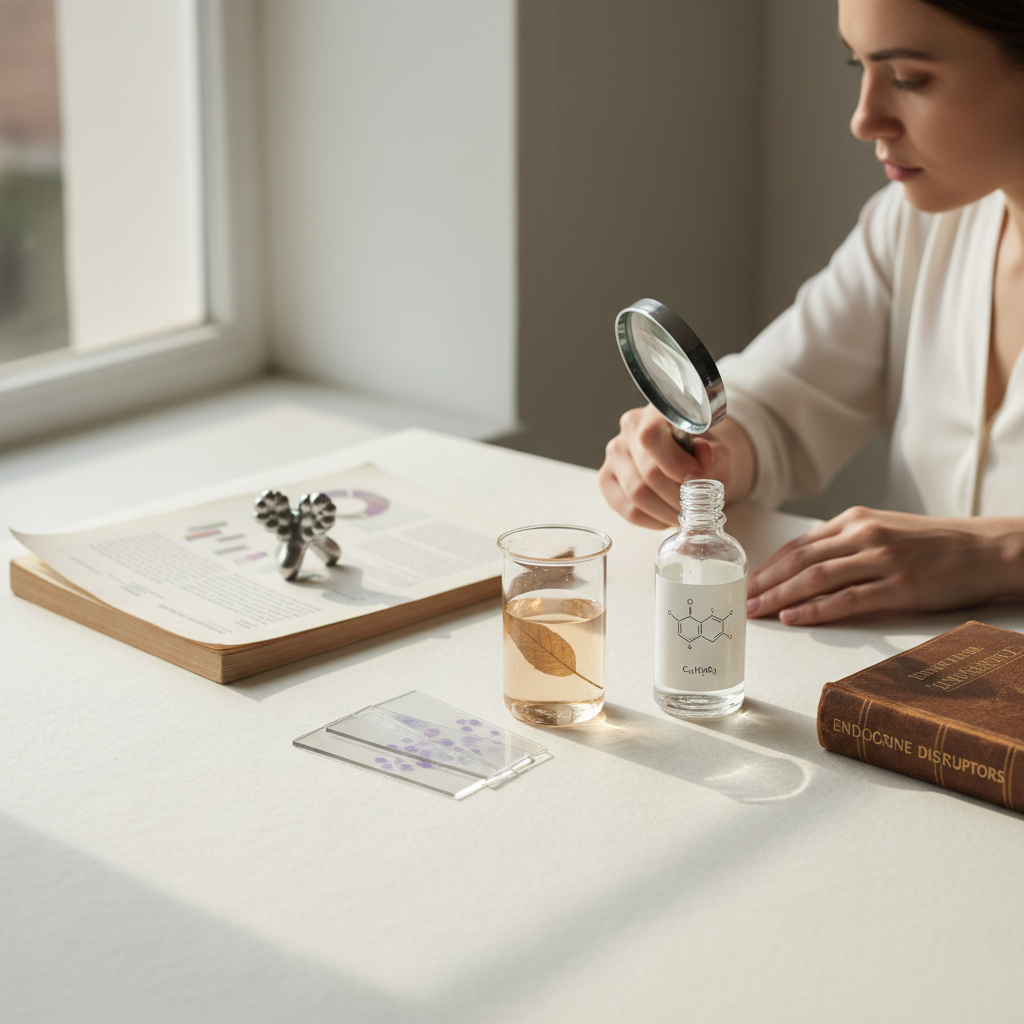
[!answer] Benzophenone-3 (also known as oxybenzone) is a chemical UV filter that is absorbed through the skin into the bloodstream. It is recognized as an endocrine-disrupting chemical (EDC), and while regulatory bodies permit its use, ongoing research is actively investigating its potential contribution to hormonal-related conditions like Polycystic Ovary Syndrome (PCOS).
It is one of the most common ingredients in chemical sunscreens, valued for its ability to protect our skin from the sun. Yet the very mechanism that makes it a staple in our beach bags—its ability to be absorbed by the skin—is also why its broader effects on the body are a subject of calm, but consistent, scientific inquiry.
What is benzophenone-3 and why is it used?
Benzophenone-3, more commonly known as oxybenzone, is an organic compound used primarily as a chemical UV filter in sunscreens and other personal care products. Unlike mineral sunscreens (like zinc oxide or titanium dioxide) that create a physical barrier to block UV rays, chemical filters like benzophenone-3 work by absorbing UV radiation and converting it into a less damaging form of heat [6]. Its effectiveness across a broad spectrum of UV light has made it a go-to ingredient for decades, offering protection that feels lightweight and transparent on the skin.
Its function isn't limited to sun care. You can also find it in lotions, lip balms, and even hair care products where it serves a dual purpose: protecting the skin or hair from sun damage and preventing the product formulation itself from degrading in the presence of UV light. Its prevalence is a testament to its efficacy as a photostabilizer.
However, the properties that make it an effective, absorbable sunscreen agent are also what place it under the scientific microscope. Because it is designed to be applied liberally over large areas of the body and left on for hours, its potential for systemic absorption is higher than for many other cosmetic ingredients.
Does benzophenone-3 get absorbed into the body?
Yes, there is clear and established evidence that benzophenone-3 is absorbed through the skin and enters the bloodstream. Numerous biomonitoring studies have detected benzophenone-3 and its metabolites in human blood, urine, and even amniotic fluid and breast milk [2]. This systemic absorption is not a point of scientific debate—it is a known characteristic of the ingredient.
This is a key reason why regulatory agencies and independent researchers are paying close attention to its safety profile. An ingredient that stays on the surface of the skin generally poses a risk only of local irritation or allergy. But an ingredient that is systemically absorbed, like oxybenzone from your sunscreen, must be evaluated for its potential effects on the entire body. The mere presence of a substance in the bloodstream doesn't automatically mean it is harmful, but it does mean that questions about its biological activity become much more important.
[!quote] Increasing evidence highlights the contribution of environmental factors, particularly endocrine-disrupting chemicals (EDCs), to PCOS susceptibility and severity. Sunscreen ultraviolet (UV) filters such as oxybenzone (benzophenone-3) ... are widely used EDCs with established systemic absorption and biomonitoring evidence. — [1]
What does it mean to be an 'endocrine disruptor'?
An endocrine-disrupting chemical, or EDC, is a compound that can interfere with the body's endocrine (or hormone) system. These chemicals can cause a variety of adverse effects by mimicking natural hormones, blocking their action, or altering their production, transport, or metabolism [3]. Hormones are the body's chemical messengers, regulating everything from growth and metabolism to mood and reproductive function. Even small interferences can, over time, have significant biological effects.
The challenge with EDCs is that their effects don't always follow a traditional toxicological model where "the dose makes the poison." For hormones, timing and sensitivity are everything. Exposures during critical developmental windows (like in the womb or during puberty) can have lifelong consequences. Furthermore, the effects of EDCs can be complex and are often the result of cumulative exposure from multiple sources over many years [3].
Benzophenone-3 is identified as an EDC because laboratory studies have shown it can exhibit weak estrogenic and anti-androgenic activity. This means it can weakly mimic the female hormone estrogen and block the action of male hormones like testosterone. This hormonal activity is the primary reason for the ongoing research into its safety, especially for vulnerable populations. For those looking to be proactive, learning how to spot potential EDCs is a useful skill when reading ingredient lists, an area we explore in our guide to endocrine disruptors in cosmetics.
What is the evidence linking benzophenone-3 to specific health conditions?
The most specific and recent research raising concerns about benzophenone-3 centers on its potential link to Polycystic Ovary Syndrome (PCOS). PCOS is a complex hormonal and metabolic disorder affecting a significant percentage of women of reproductive age [1]. A 2024 review in the journal Toxics specifically examined the role that sunscreen filters, including benzophenone-3, might play in this condition.
The authors highlight that given its known anti-androgenic and estrogenic activities, benzophenone-3's widespread use and systemic absorption present a plausible risk factor for aggravating or contributing to PCOS in susceptible individuals. The research suggests that exposure could disrupt the delicate hormonal balance that is already askew in those with PCOS, potentially worsening symptoms like hyperandrogenism (elevated androgen levels) and ovulatory dysfunction [1].
It is crucial to frame this correctly: the research does not suggest that using sunscreen causes PCOS. PCOS is a multifaceted condition with strong genetic and metabolic components. Rather, the evidence suggests that for individuals already predisposed to the condition, exposure to EDCs like benzophenone-3 could be a contributing environmental factor that influences its severity or expression [1]. This aligns with the broader understanding of EDCs, which often act as one of many hits in a complex disease process [3].
How do we assess the risk of chemical mixtures?
One of the most complex areas of toxicology is understanding how we are affected not by single chemicals, but by the mixtures we encounter every day. We are never exposed to just benzophenone-3 in a vacuum. A single person might be exposed to benzophenone-3 from their sunscreen, phthalates from a fragranced lotion, and parabens from their shampoo, all in one morning routine [2][3].
Scientists refer to this as the "cocktail effect." The current approach to chemical risk assessment often falls short because it analyzes substances one by one, potentially missing the synergistic effects of the mixture [3]. Endocrine disruption is a key area where these mixture effects are a concern. Several weak EDCs acting together might produce a significant hormonal effect that none would trigger on its own.
This complexity is why establishing a direct, causal link between a single EDC and a specific disease in humans is so difficult. Research often relies on epidemiological studies that find associations and laboratory studies that show biological plausibility. While neither is definitive proof on its own, when both lines of evidence point in the same direction—as they do for benzophenone-3 and hormone disruption—it signals that careful consideration is warranted.
Who should be more cautious?
Based on the scientific evidence, certain individuals may wish to be more cautious about their exposure to benzophenone-3. The research on PCOS specifically flags women of reproductive age, particularly those with a personal or family history of the condition or those already experiencing symptoms of hormonal imbalance [1]. Given that the endocrine system is particularly vulnerable during periods of development, many experts also advise a more precautionary approach for pregnant women and young children.
Additionally, individuals with high occupational exposure, such as hairdressers who handle numerous products containing UV filters and other EDCs daily, might also have a higher cumulative exposure risk over their lifetime [2]. While a client may have intermittent exposure, a stylist’s is chronic and multifaceted. This highlights the importance of context in risk assessment.
For most healthy adults without specific hormonal concerns, regulatory bodies have determined that the concentration of benzophenone-3 used in sunscreens (up to 6% in the U.S.) is safe. The risk of sun damage and skin cancer is well-established and significant, and effective sun protection is paramount. The choice is not necessarily between using a product with benzophenone-3 and using nothing, but between different types of available sunscreens.
How can you make an informed choice?
If you prefer to avoid benzophenone-3, you have excellent, effective alternatives. Reading the ingredient label is the most straightforward way to identify it. Look for "Oxybenzone" or "Benzophenone-3" in the “Active Ingredients” list on a sunscreen label.
Mineral-based sunscreens are the most common alternative. These formulations use zinc oxide and/or titanium dioxide as their active ingredients. These minerals are not absorbed into the skin; they sit on top and create a physical barrier that reflects and scatters UV radiation [6]. Once considered thick and opaque, modern mineral sunscreens have vastly improved cosmetically, with micronized and tinted versions that blend into the skin with minimal white cast.
Ultimately, making an informed choice is about weighing the established science, your personal health context, and your preferences. The conversation around benzophenone-3 isn't about fear, but about a growing body of nuanced scientific evidence. Knowing how to spot potential endocrine disruptors on a label gives you the power to choose what feels right for you.
The takeaway
Benzophenone-3 is a proven, systemically absorbed endocrine disruptor, and a growing body of evidence is investigating its link to hormonal conditions like PCOS. While its use in sunscreen is approved by regulators, many effective mineral-based sunscreens using zinc oxide and titanium dioxide are available for those who prefer to avoid it. The best sunscreen is the one you will actually use, and today’s market provides safe and effective options for every preference.
Sources
- [1] Polycystic Ovary Syndrome (PCOS)-Specific Risk Appraisal of the Sunscreen Ultraviolet (UV) Filters (Oxybenzone/Octinoxate). — Dutta S, Sengupta P, Chhikara BS, Formicki G, Rosas IM, Roychoudhury S.. 2025 · Europe PMC
- [2] Recent developments in sunscreens based on chromophore compounds and nanoparticles. — Rajasekar M, Mary J, Sivakumar M, Selvam M.. 2024 · Europe PMC
- [3] The ENDOMIX perspective: how everyday chemical mixtures impact human health and reproduction by targeting the immune system†. — Gómez-Olarte S, Mailänder V, Castro-Neves J, Stojanovska V, Schumacher A, Meyer N, Zenclussen AC.. 2024 · Europe PMC
- [4] Occupational Exposure to Resorcinol and Thyroid-Disrupting Effects: Protocol for an Exploratory Field Study in French Hairdressers. — Radauceanu A, Cambrai-Erb A, Adet B, Nioule MI, Denis F, Pons R.. 2026 · Europe PMC