Studies
Phthalates and Ovarian Health: Understanding POI Risk
You can support your long-term ovarian health. Learn how to identify and reduce contact with phthalates in your daily life.
September 27, 2026
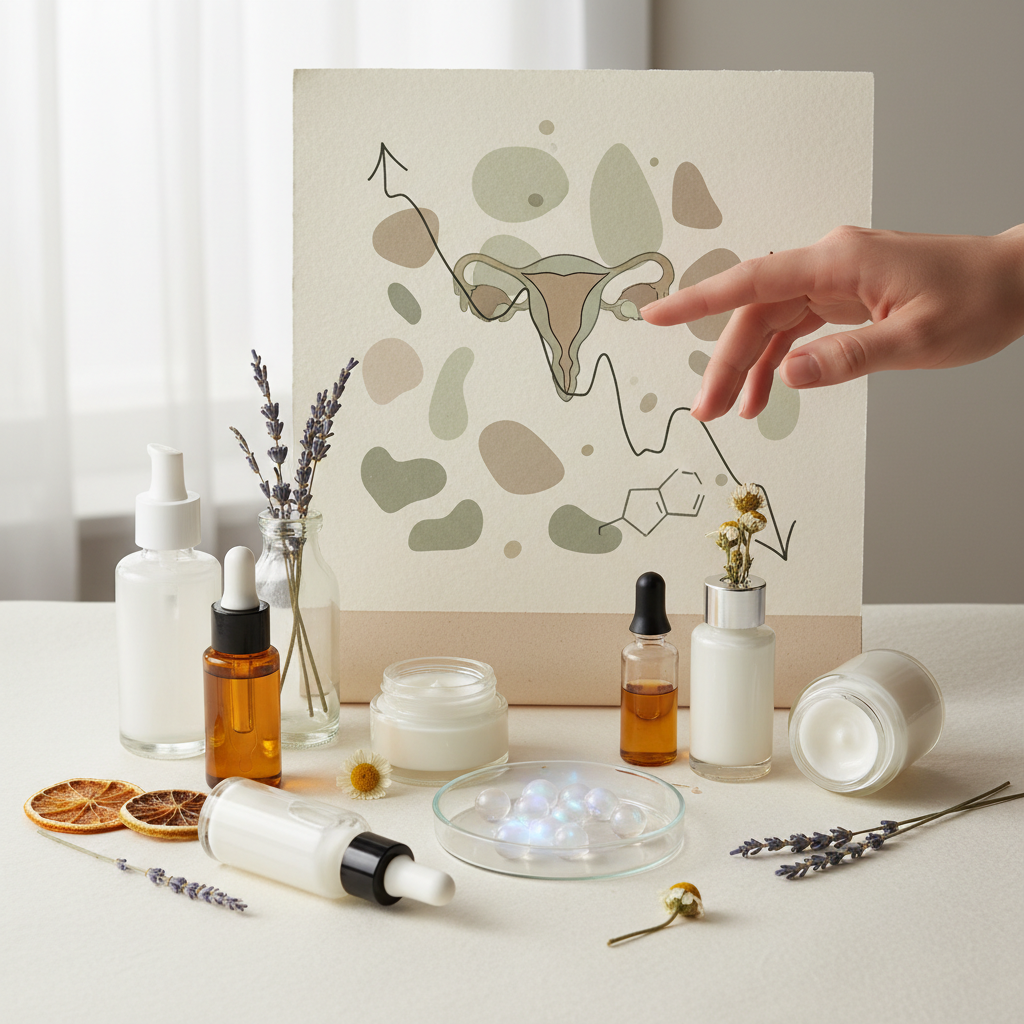
[!answer]You can support your long-term ovarian health with a few key choices. Smart shopping helps you lower your contact with chemicals like phthalates. This guide shows you how.
What Are Phthalates?
Phthalates are a family of synthetic chemicals.
Manufacturers use them to make plastics more flexible. They also help fragrances in products last longer. People often call phthalates “everywhere chemicals.” They appear in many common consumer goods. Manufacturers add them to make vinyl plastics like PVC soft and durable. In cosmetics, they act as solvents and help scents linger.
Phthalates are not chemically part of the products they are in. This means they can be released over time. This leads to widespread, low-level human contact from many sources [1].
Where Are Phthalates Found?
You can find phthalates in many common goods. This makes it hard to avoid them completely. Common sources include:
- Vinyl flooring and shower curtains
- Food packaging and plastic wrap
- Medical devices and tubing
- Perfumes, nail polish, and hair spray
In cosmetics, phthalates can be hard to spot on a label. Companies often group them under the word “fragrance” or “parfum.” This makes it hard for people to know if a product contains them.
How Do Phthalates Affect Ovarian Health?
Phthalates may affect the body’s hormonal system. This system is key for healthy ovarian function. These chemicals are a type of endocrine-disrupting chemical, or EDC.
The endocrine system is your body’s network of glands. These glands produce hormones. Hormones are chemical messengers that control many body functions. EDCs can interfere with this delicate system [1].
Your reproductive system is very sensitive to hormonal changes. EDCs can mimic your natural hormones. They can also block hormones. Or they can change how your body makes them. The ovaries rely on a fine balance of hormones. A chemical that disrupts this balance could cause problems.
Endocrine disrupting chemicals (EDCs), characterized by hormone-like effects, have a wide range of influences on the reproductive system. EDCs are ubiquitous in the natural environment and are present in a wide range of industrial and everyday products. — [1]
What Is Ovarian Reserve?
Ovarian reserve is a term for the number and quality of eggs. It is a key sign of a woman’s fertility potential. A higher reserve means a larger supply of healthy eggs.
Doctors use two main tests to check ovarian reserve. One measures Anti-Müllerian Hormone (AMH) in the blood. The other uses an ultrasound to count antral follicles (AFC). Ovarian reserve naturally goes down with age. This decline usually speeds up in a woman's late 30s. It leads to menopause around age 50. Some factors, however, can make this process happen faster.
What Does Research Show About Phthalates and Ovarian Reserve?
Recent research shows a link between phthalates and lower ovarian reserve. Studies connect higher phthalate levels in the body to lower markers of fertility.
A 2025 systematic review looked at many studies on this topic [2]. The review found that women with more phthalate byproducts in their urine had lower AMH levels. This finding appeared in multiple studies. This suggests that phthalate contact might speed up the natural decline of a woman’s egg supply. It points to a clear association. But it does not prove that one causes the other.
Do Phthalates Cause Premature Ovarian Insufficiency?
The science shows a strong link, but not a proven cause. Premature ovarian insufficiency, or POI, is a condition where the ovaries stop working normally before age 40. It affects about 1 in 100 women.
At this time, evidence shows a strong correlation. It does not prove a direct cause-and-effect relationship. Think of it this way: two things happen together. But it is very hard to prove one causes the other in humans. However, the repeated findings are a cause for concern. They suggest phthalates could be a key factor in ovarian aging. This may increase the risk of developing POI.
How Do Scientists Study This Link?
Researchers use three main types of studies. Each type provides different information. Together, they build a picture of how phthalates might affect health.
Human Studies
These studies look for patterns in large groups of people. Scientists measure phthalate byproducts in urine. They compare these levels to fertility markers like AMH. These studies show strong links but cannot rule out other lifestyle factors.
Animal Studies
In a lab, scientists can expose animals to certain phthalates. Then they can directly see the effects on the ovaries. These studies often show more direct evidence of harm. For example, they may show fewer healthy eggs. But results in animals do not always apply to humans.
Lab Studies
Scientists can also expose single ovarian cells to phthalates. This helps them see the specific biological effects. For example, they can see how phthalates might cause cell death. These studies show how the damage could happen at a cellular level.
How Can You Reduce Phthalate Contact?
You can lower your contact by choosing products carefully. It is nearly impossible to avoid phthalates completely. But a few practical steps can greatly reduce your contact.
- Read cosmetic labels. Look for "phthalate-free" products. Be careful with the word "fragrance," as it can hide phthalates. Choose fragrance-free items or those using essential oils.
- Avoid certain plastics. Phthalates soften vinyl or PVC plastic. This plastic is marked with recycling code #3. Try to avoid food and drinks in this plastic. Choose glass, steel, or safer plastics #1, #2, #4, or #5.
- Eat more fresh food. Phthalates can enter processed foods from packaging. Eating more whole foods can reduce this source of contact.
- Choose safer home products. Opt for shower curtains, raincoats, and flooring made from materials other than vinyl when you can.
The Takeaway
A growing amount of research connects phthalate contact with lower ovarian function. A direct causal link to premature ovarian insufficiency is not yet proven. However, the strong and consistent association is a major public health concern. Women may wish to take steps to lower their contact with these chemicals. This is especially true for cosmetics and food packaging.
Sources
- [1] The adverse role of endocrine disrupting chemicals in the reproductive system. — Pan J, Liu P, Yu X, Zhang Z, Liu J.. 2023 · Europe PMC
- [2] Assessment of ovarian dysfunction induced by environmental toxins: a systematic review. — An L, Huang Y, Wang Y, Shen S, Luo X, Liang X, Lu L, Tang C, Lin J, Su T, Zhan M, Wang D, Wang J, Lai X, Li Y.. 2025 · Europe PMC