Guides
Spotting Allergens in Facial Cleansers: A Label Guide
To identify common allergens in facial cleansers, check the ingredient list for fragrance, specific preservatives like methylisothiazolinone, and certain.
May 22, 2026
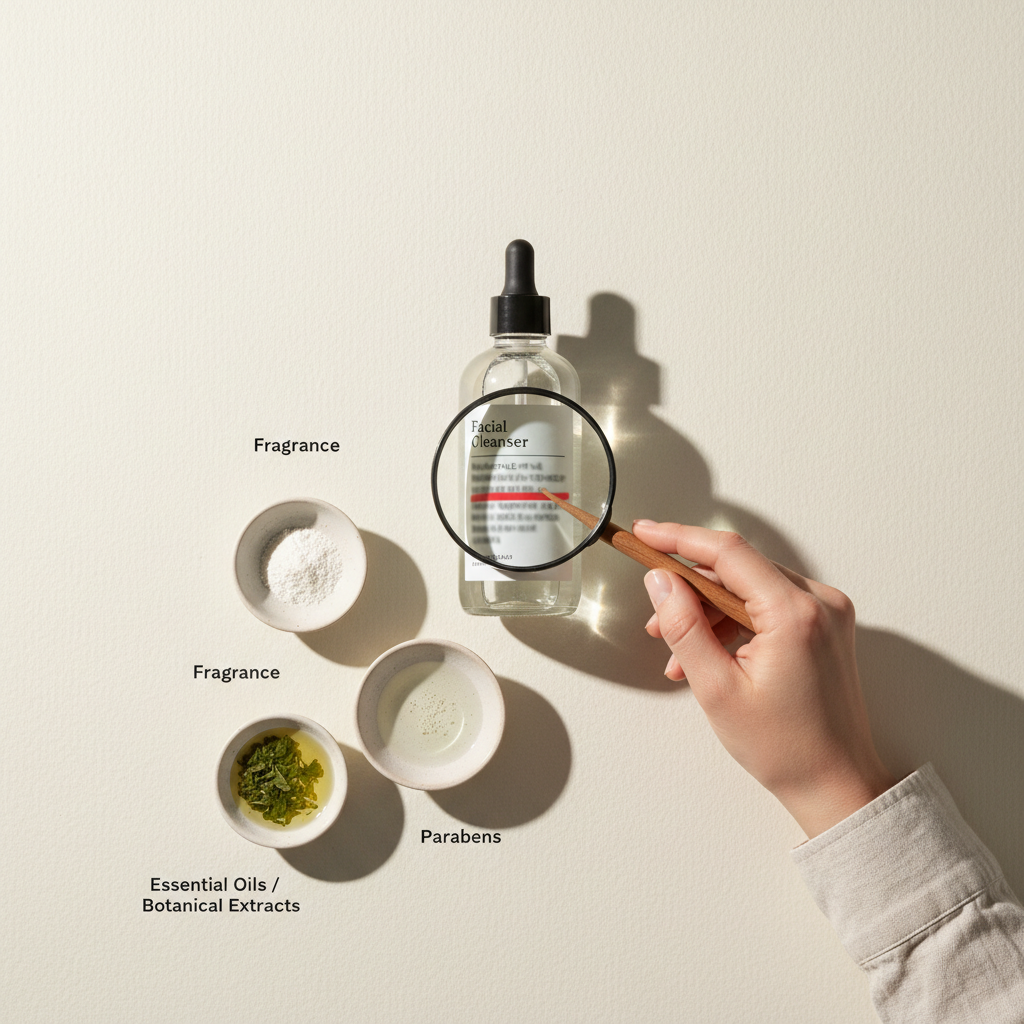
[!answer] To identify common allergens in facial cleansers, scrutinize the ingredients list for three main categories: fragrances (listed as 'parfum'), specific preservatives like methylisothiazolinone (MI) and methylchloroisothiazolinone (MCI), and certain botanical extracts. These components are the most frequent triggers of allergic contact dermatitis, an immune reaction that can develop from repeated exposure.
Your facial cleanser is a foundational part of your skincare routine, but its brief time on your skin doesn't render it harmless. Over months and years, even short, repeated exposure to certain ingredients can sensitize your immune system, leading to a condition known as allergic contact dermatitis (ACD). Understanding how to read an ingredient label is the most powerful tool for preventing this frustrating, and sometimes debilitating, skin reaction.
What is allergic contact dermatitis?
Allergic contact dermatitis (ACD) is a specific type of immune response, not to be confused with general irritation [1]. Whereas an irritant (like a harsh acid) would damage anyone's skin on contact, an allergen only causes a reaction in individuals whose immune systems have been "trained" to recognize it as a threat. This sensitization process happens over time. You might use a product with a potential allergen for years with no issue, until one day your body's threshold is crossed, and a reaction—often appearing as a red, itchy, eczema-like rash—develops.
This delayed, acquired sensitivity is a hallmark of ACD. The condition is not a single, simple reaction but involves multiple inflammatory pathways in the skin [1]. Once you become allergic to a substance, you are typically allergic for life, and any future contact will trigger the dermatitis, often more quickly and severely than the last. This is why identifying and avoiding the specific trigger is the cornerstone of managing the condition.
Why are cleansers a source of allergies?
Cleansers might seem less risky than leave-on products like moisturizers or serums, but they present a unique challenge to the skin barrier. The very ingredients that make them effective at removing dirt and oil—surfactants—can also temporarily disrupt the protective outer layer of the skin. This brief disruption can create an opportunity for potential allergens within the formula to penetrate more deeply and come into contact with immune cells. Over time, this cumulative exposure can lead to sensitization.
Beyond surfactants, cleansers contain other ingredients necessary for their function and stability that are also well-known potential allergens. Preservatives are essential to prevent the growth of bacteria, mold, and yeast in the water-based formula. Fragrances are added for sensory appeal. Each of these ingredient categories contains well-documented allergens that are frequent culprits in cases of facial ACD.
Which ingredients are the most common culprits?
When scanning a cleanser's ingredient list, three categories warrant the closest attention: fragrances, preservatives, and botanical extracts. These groups account for the majority of allergic reactions to cosmetic products.
Fragrance: Dermatologists consistently identify fragrance as the leading cause of allergic contact dermatitis from cosmetics. Labels may use the simple term "Fragrance" or "Parfum," which can represent a complex mixture of dozens or even hundreds of individual chemicals. While regulations in some regions require listing specific known fragrance allergens (like Linalool, Limonene, or Geraniol), the umbrella term can hide many potential triggers. For those with sensitive skin, "fragrance-free" is often the safest bet. Even "unscented" products may contain masking fragrances to cover the chemical smell of other ingredients.
Preservatives: Perhaps the most notorious allergens in wash-off products belong to the isothiazolinone family. Methylisothiazolinone (MI) and Methylchloroisothiazolinone (MCI) are highly effective preservatives that became extremely common in the 2000s, leading to what some dermatologists termed an "epidemic" of MI allergy. While now more restricted, especially in leave-on products, they are still found in some cleansers. If you have persistent or unexplained eczema, checking your face wash for these ingredients is a critical step; you can learn more about this specific preservative in our deep-dive on methylisothiazolinone and its link to eczema.
Other preservatives like formaldehyde-releasers (e.g., DMDM Hydantoin, Diazolidinyl Urea) can also be allergenic for some. In contrast, preservatives like phenoxyethanol are currently considered to have a much lower sensitization potential a topic covered in our phenoxyethanol safety review.
[!quote] ACD is not a single immunologic phenomenon but rather has contributions from multiple inflammatory pathways. — [1]
Aren't “natural” or “botanical” cleansers safer?
No, in fact, they can be a significant source of allergens. The growing consumer demand for plant-based cosmetics is driven by the perception that natural ingredients are inherently healthier and safer [3]. However, from a chemical perspective, a "botanical extract" is an incredibly complex mixture of compounds, any one of which could be a potential allergen. Poison ivy is 100% natural, but you wouldn't cleanse your face with it.
Many common and popular botanical ingredients are known to cause allergic contact dermatitis. These include tea tree oil, lavender, chamomile, calendula, and other members of the Compositae plant family (which also includes ragweed). An allergy to one plant in a family can sometimes mean you'll react to related plants, a phenomenon known as cross-reactivity. If you have known hay fever or allergies to certain plants, be cautious about using them on your skin.
This doesn't mean all plant extracts are bad—many have wonderful antioxidant and soothing properties. It simply means that "natural" does not equal "non-allergenic." The principles of chemistry and immunology apply to all ingredients, regardless of their origin.
[!quote] The global consumption of plant-based cosmetics has shown spectacular growth in recent years because of rising consumer awareness regarding the long-term health benefits of natural ingredients. — [3]
What about "hypoallergenic" or "for sensitive skin" claims?
These terms are primarily for marketing and have no standardized or regulated definition in most parts of the world. A company can label its product "hypoallergenic" without any specific testing or ingredient restrictions. While brands dedicated to sensitive skin often do make an effort to formulate without common allergens, the label itself is not a guarantee of safety for your specific skin.
Ultimately, the ingredient list is the only source of truth. Learning to read it is more reliable than trusting front-of-bottle claims. Similar to how terms like "natural" or "organic" can be misused, "hypoallergenic" can provide a false sense of security. Verifying what is—and isn't—in the bottle is an essential skill, much like learning to verify cosmetic certifications.
How do I read the ingredient list (INCI)?
Reading a cosmetic label, or INCI (International Nomenclature of Cosmetic Ingredients) list, is a skill that empowers you to make informed choices. Ingredients are listed in descending order by weight, down to 1%. Below 1%, they can be listed in any order. For a cleanser, this means water and the main surfactants will be at the top.
Here’s a simple process to scan for allergens:
- Look for Fragrance: Scan the list for "Fragrance," "Parfum," or "Aroma." If it's present, the risk of reaction is immediately higher for sensitive individuals. Also look for common fragrance allergens listed individually, like Limonene, Linalool, Citronellol, and Geraniol.
- Scan for Preservatives: Look near the end of the list for preservatives. Pay special attention to Methylisothiazolinone and Methylchloroisothiazolinone.
- Note the Botanicals: If you see plant names (often in Latin, like Lavandula Angustifolia for lavender), essential oils (
- Oil), or extracts (- Extract), be mindful, especially if you have known plant allergies or very reactive skin.
The same principles for reading an ingredient list apply to other products as well, and you can see a similar process in our guide to identifying moisturizer allergens.
Is this different for children?
Yes, the stakes are higher for children. Their skin is thinner and their skin barrier and immune systems are still developing, making them more vulnerable to developing allergies [1]. Research has noted a concerning rise in pediatric allergic contact dermatitis, with personal care products being a significant source of exposure [1].
For children, it is especially prudent to choose cleansers free of fragrance and common allergenic preservatives like MI. Exposure to allergens in early life can lead to a lifetime of sensitivity. Choosing a simple, gentle formula is key. For more on this, you can explore our guide to kids' shampoos, which shares many of the same ingredient considerations.
The takeaway
Choosing the right facial cleanser when you have sensitive or allergy-prone skin requires you to become a label detective. Prioritize products that are free of fragrance, and carefully check the preservative system for known triggers like MI/MCI. Remember that "natural" and "hypoallergenic" are not guarantees, and patch-testing a new product on a small area of skin before applying it to your full face is always the wisest course of action.
Sources
- [1] What We Have Learned-Milestones in Pediatric Contact Dermatitis. — Dupuy E, Miller M, Harter N.. 2022 · Europe PMC
- [2] Hidden and Rare Food Allergens in Pediatric Age. — Tomei L, Muraro A, Giovannini M, Barni S, Liccioli G, Paladini E, Sarti L, Pessina B, Skypala I, Novembre E, Mori F.. 2023 · Europe PMC
- [3] Global Perspective of Plant-Based Cosmetic Industry and Possible Contribution of Sri Lanka to the Development of Herbal Cosmetics. — Nadeeshani Dilhara Gamage DG, Dharmadasa RM, Chandana Abeysinghe D, Saman Wijesekara RG, Prathapasinghe GA, Someya T.. 2022 · Europe PMC
- [4] Topical anti-inflammatory treatments for eczema: network meta-analysis. — Lax SJ, Van Vogt E, Candy B, Steele L, Reynolds C, Stuart B, Parker R, Axon E, Roberts A, Doyle M, Chu DK, Futamura M, Santer M, Williams HC, Cro S, Drucker AM, Boyle RJ.. 2024 · Europe PMC
- [5] Skin care interventions in infants for preventing eczema and food allergy. — Kelleher MM, Phillips R, Brown SJ, Cro S, Cornelius V, Carlsen KCL, Skjerven HO, Rehbinder EM, Lowe AJ, Dissanayake E, Shimojo N, Yonezawa K, Ohya Y, Yamamoto-Hanada K, Morita K, Axon E, Cork M, Cooke A, Van Vogt E, Schmitt J, Weidinger S, McClanahan D, Simpson E, Duley L, Askie LM, Williams HC, Boyle RJ.. 2022 · Europe PMC
- [6] Skin care interventions in infants for preventing eczema and food allergy. — Kelleher MM, Cro S, Cornelius V, Lodrup Carlsen KC, Skjerven HO, Rehbinder EM, Lowe AJ, Dissanayake E, Shimojo N, Yonezawa K, Ohya Y, Yamamoto-Hanada K, Morita K, Axon E, Surber C, Cork M, Cooke A, Tran L, Van Vogt E, Schmitt J, Weidinger S, McClanahan D, Simpson E, Duley L, Askie LM, Chalmers JR, Williams HC, Boyle RJ.. 2021 · Europe PMC
- [7] OpenFDA Cosmetic Adverse Event Report (#1). FDA Adverse Event Reporting System (2022) · OpenFDA
- [8] OpenFDA Cosmetic Adverse Event Report (#2). FDA Adverse Event Reporting System (2017) · OpenFDA
- [9] OpenFDA Cosmetic Adverse Event Report (#3). FDA Adverse Event Reporting System (2014) · OpenFDA
- [10] OpenFDA Cosmetic Adverse Event Report (#4). FDA Adverse Event Reporting System (2023) · OpenFDA