Ingredients
The Role of Resorcinol in Hair Dye: A Safety Guide
Resorcinol in hair dye contributes to stable color but is a known skin allergen and potential endocrine disruptor, raising safety concerns.
July 8, 2026
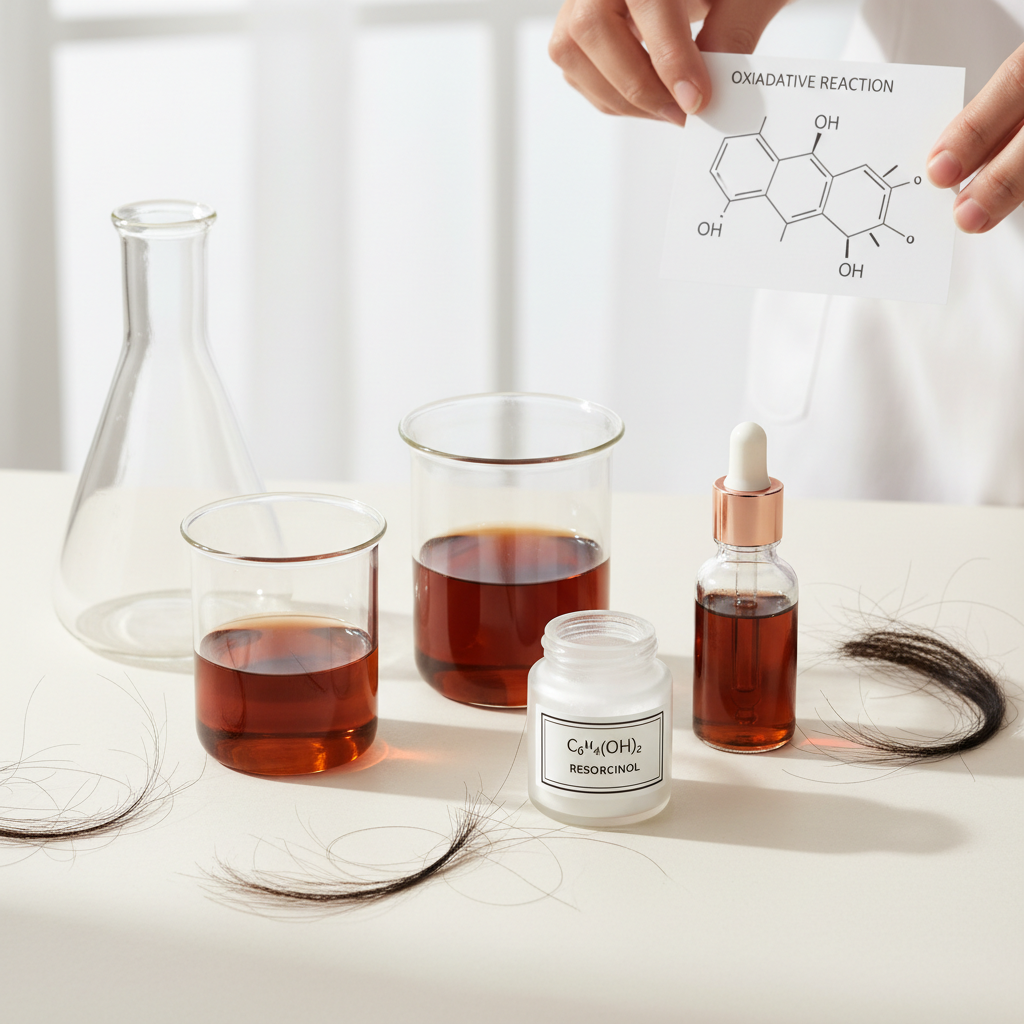
[!answer] Resorcinol is a color coupler used in permanent oxidative hair dyes to create and stabilize specific shades. It is a well-documented skin sensitizer that can cause allergic contact dermatitis. While some studies raise concerns about potential endocrine-disrupting effects, regulators currently consider it safe at the low concentrations used in rinse-off hair products.
Resorcinol has been a workhorse of the hair color industry for decades, valued for its ability to create rich, lasting tones. But as we look more closely at the ingredients in our daily lives, its safety profile warrants a more nuanced conversation, balancing its technical efficacy against potential health considerations.
What is resorcinol and what does it do in hair dye?
Resorcinol is a chemical compound that acts as a color “coupler” or “modifier” in permanent, oxidative hair dye formulations. It doesn’t create color on its own. Instead, it reacts with a primary intermediate (like p-Phenylenediamine, or PPD) and an oxidizing agent (typically hydrogen peroxide) to form the final, stable color molecules that give hair its new shade [1]. This entire reaction takes place within the hair shaft, which is why permanent color lasts so long.
The specific role of resorcinol is to create certain tones, particularly warmer shades like browns, auburns, and dirty blondes. By modifying the primary color that forms, it provides a level of artistry and control, allowing for a spectrum of nuanced results beyond a single flat color. It’s part of a family of chemicals known as phenolic compounds and is essential for achieving many of the most popular hair colors on the market [1].
This process is what defines oxidative dyeing. Small precursor molecules—the intermediates and couplers—penetrate the hair’s outer cuticle, enabled by the alkaline environment of the dye mixture. Once inside, the peroxide triggers the chemical reaction, causing these small molecules to link together into large, complex polymers. These new color polymers are too big to be washed out, effectively locking the color inside the hair strand until it grows out.
Is resorcinol a known skin allergen?
Yes, resorcinol is a well-established contact allergen. Its potential to cause skin sensitization is one of the most documented health concerns associated with the ingredient. When someone who is allergic comes into contact with it, their immune system can trigger a reaction known as allergic contact dermatitis, which can appear on the scalp, hairline, neck, face, or hands [2]. Symptoms often include redness, itching, swelling, and sometimes blistering.
Decades of dermatological data confirm this risk. A large-scale analysis of patch test data collected in Central Europe from 1995 to 2020 consistently identified resorcinol as a relevant sensitizer from hair cosmetics [2]. While it is not the most frequent cause of hair dye allergy—an honor that belongs to PPD and its relatives—it remains a significant one. Because of this, regulators in both the European Union and the United States require its presence to be clearly disclosed on ingredient labels and mandate a warning to perform a skin allergy test (patch test) before each use.
[!quote] Oxidative hair dyeing is a complex chemical process that builds large, stable color polymers inside the hair shaft from small precursor molecules. — [1]
It’s important to understand that an allergy to resorcinol can develop over time, even if you have used products containing it for years without issue. This is why the advice to perform a patch test 48 hours before every single application is critical for consumer safety. Finding a positive reaction on a patch test is a clear signal to avoid any hair dye containing the ingredient.
What does the research say about endocrine disruption?
Several scientific studies have investigated whether resorcinol could act as an endocrine-disrupting chemical (EDC), meaning it might interfere with the body's hormonal system. Most of the concern centers on its potential effects on the thyroid gland. Some in vitro (test tube) and animal studies have shown that at certain concentrations, resorcinol can inhibit thyroid peroxidase, an enzyme essential for producing thyroid hormones. This has led to its classification as a potential EDC by some researchers.
However, context is crucial. The concentrations used in many of these laboratory studies are significantly higher than the levels a person would be exposed to during a typical hair dyeing session. Regulatory bodies like the EU’s Scientific Committee on Consumer Safety (SCCS) have reviewed the evidence extensively. Their conclusion is that when used in rinse-off oxidative hair dye formulations at the permitted concentration (currently a maximum of 1.25% in the final, ready-to-use mixture), resorcinol is considered safe for consumers.
The reasoning hinges on exposure. Hair dye is applied intermittently—typically every 4 to 8 weeks—and remains on the head for under an hour before being thoroughly rinsed off. Dermal absorption during this short window is low. While the scientific community continues to study the long-term effects of low-dose exposure to potential EDCs, the current regulatory consensus is that the risk from resorcinol in hair dye is minimal for the average user. For those who wish to be more cautious, learning how to spot potential endocrine disruptors on a label is a helpful skill.
Who should be most cautious with resorcinol?
While regulators deem resorcinol safe for the general population under normal use conditions, certain groups should exercise greater caution. The first and most obvious group is anyone with a known or suspected allergy to resorcinol. If a patch test has ever shown a reaction, all products containing it should be strictly avoided.
Professionals in the beauty industry, particularly hairdressers, face a much higher level of exposure. They handle hair dye products daily, leading to frequent and prolonged skin contact on their hands, as well as potential inhalation of fumes. Studies confirm that hairdressers have significantly higher rates of sensitization to hair dye ingredients, including resorcinol, than their clients [2]. For professionals, wearing protective nitrile gloves is not just a recommendation but an essential safety practice to minimize occupational health risks, which also include respiratory issues from airborne salon chemicals. The cumulative exposure over a career is a serious consideration, as discussed in reviews on air quality in hair salons.
Individuals with compromised skin barriers on their scalp, such as those with active eczema, psoriasis, or open sores, should also be cautious. A damaged skin barrier may allow for greater absorption of chemicals into the bloodstream, potentially increasing the risk of both sensitization and systemic exposure. Finally, individuals who are pregnant or trying to conceive, or those with pre-existing thyroid conditions, may choose to avoid potential endocrine disruptors like resorcinol out of an abundance of caution, even if the proven risk is low.
[!quote] Analysis of over two decades of patch test data confirms that sensitivity to key hair dye ingredients remains a significant concern for both consumers and professionals. — [2]
How can I tell if a hair dye contains resorcinol?
Identifying resorcinol in a hair dye product is straightforward if you know how to read the ingredient list. By law, all cosmetic ingredients must be listed on the packaging, typically in descending order of concentration. Look for the name Resorcinol on the INCI (International Nomenclature of Cosmetic Ingredients) list, which is usually found on the side or back of the box.
It’s also wise to be aware of related compounds. For example, 2-Methylresorcinol is a common alternative that functions similarly. If you are sensitive to resorcinol, you may or may not be sensitive to its relatives, but it’s a possibility worth discussing with a dermatologist. Some other common couplers you might see on a label include m-Aminophenol, p-Aminophenol, and N,N-Bis(2-Hydroxyethyl)-p-Phenylenediamine Sulfate.
In some countries, regulations also require a written warning on the packaging, such as "Contains resorcinol." This serves as an immediate flag. However, the most reliable method is always to scrutinize the full ingredient list. This is particularly important because, as some studies on other dye ingredients have shown, on-shelf products can sometimes deviate from expectations, making label transparency a consumer’s best tool [3].
What are the alternatives to dyes with resorcinol?
For those who wish to avoid resorcinol due to allergy, health concerns, or personal preference, there are numerous alternatives available. Many mainstream and "clean beauty" brands now offer permanent oxidative dyes specifically formulated to be "resorcinol-free." These products use different types of coupler molecules to achieve their target shades. Checking the brand’s claims and, more importantly, the ingredient list is the best way to find them.
Another option is to move away from permanent, oxidative dyes altogether. Semi-permanent and demi-permanent colors offer a less chemically intensive alternative. These products primarily deposit color on the outside of the hair shaft and do not involve the same chemical reaction with peroxide inside the hair. They wash out over time and generally contain a different profile of colorants [1].
Finally, there are natural, plant-based dyes such as henna (from the plant Lawsonia inermis) and indigo. These have been used for centuries and work by staining the hair’s outer keratin layer. True, 100% pure henna and indigo do not contain resorcinol, PPD, or peroxide. However, they offer a very limited color palette (reds, browns, and blacks), the process can be lengthy, and the results can be less predictable. Be wary of "compound henna" or "black henna" products, which are often adulterated with synthetic dyes, including PPD, to expand their color range and can be very dangerous.
The takeaway
Resorcinol is an effective chemical coupler that is key to creating many popular shades of permanent hair color. However, it is also a known skin allergen and a potential endocrine disruptor under ongoing scientific review. For most consumers, the intermittent, low-dose exposure from at-home hair coloring is considered safe by regulatory agencies, but individuals with sensitive skin, hairdressers, and those wishing to avoid potential EDCs may want to seek alternatives.
Sources
- [1] Comprehensive Review of Hair Dyes: Physicochemical Aspects, Classification, Toxicity, Detection, and Treatment Methods. — de Souza JC, Avelino ERAF, Bessegato GG, da Costa RDCG, Carneiro PA, de Oliveira DP, Beluomini MA, Brito JF, Valnice Boldrin Zanoni M.. 2025 · Europe PMC
- [2] Contact Allergy to Ingredients of Hair Cosmetics Associated with Occupational and Non-Occupational Exposure-Trends from 1995 to 2020 in Central Europe, with or without Regulation. — Uter W, Schwensen JFB, Blömeke B, Gefeller O, John SM, Bieck C, Schubert S.. 2026 · Europe PMC
- [3] Quantification of p-Phenylenediamine in Hair Dyes and Health Risk Implications in the UAE: Describing Discordances Between Regulations and Real-Life Practices. — Jairoun AA, Al-Hemyari SS, Shahwan M, Jairoun O, Zyoud SH.. 2024 · Europe PMC